
Shopify vs WooCommerce: The Real 3-Year Cost
A transparent total-cost comparison covering subscriptions, hosting, themes, apps, development, maintenance and the sales-linked fees that can change the result.
Published: August 6, 2026 · Pricing checked August 6, 2026 · Approximate reading time: 16 minutes
See the cost model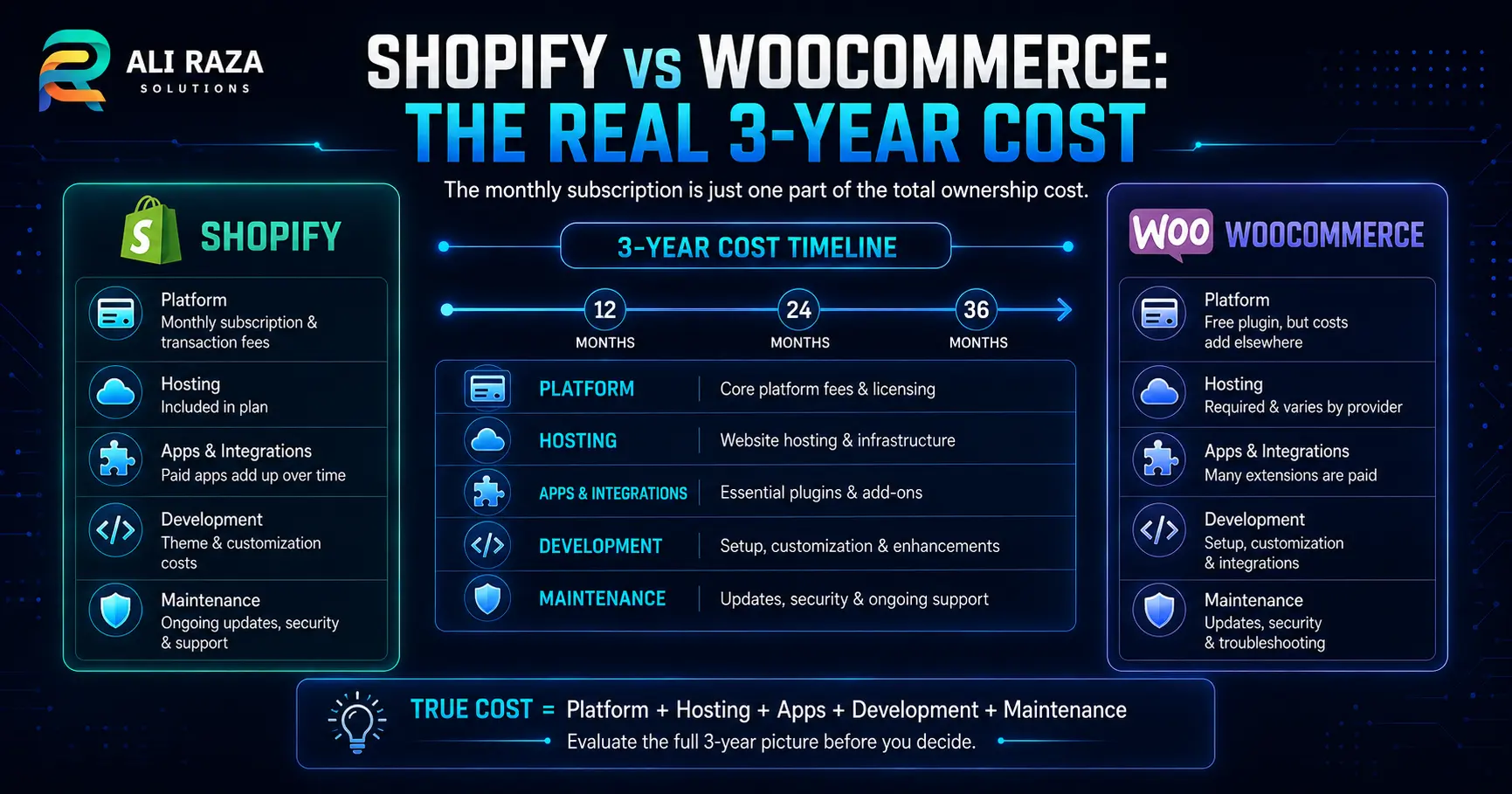
The Shopify vs WooCommerce cost question cannot be answered by comparing a Shopify subscription with the price of the free WooCommerce plugin. A fair three-year comparison includes the complete operating stack: platform or hosting, domain, theme, apps or extensions, development, maintenance, support and payment economics.
In the illustrative small-business model used in this guide, Shopify Basic totals $9,854 over three years and WooCommerce totals $12,630. Shopify is lower by $2,776 in that scenario because managed hosting reduces maintenance and the model assumes a smaller initial build. This is not a universal result. A technically capable owner can run a lean WooCommerce store for less, while a Shopify store with several paid apps or additional gateway fees can become more expensive.
Quick Answer: Shopify vs WooCommerce 3-Year Cost
Shopify Basic
$9,85436-month platform, domain, premium theme, paid apps, initial development and support.
WooCommerce
$12,63036-month hosting, domain, theme, extensions, initial development and higher maintenance allowance.
| Scenario | Shopify | WooCommerce | What drives the result? |
|---|---|---|---|
| Lean DIY | $1,104 | $960 | Free themes and features, self-managed setup, Shopify Basic at $29/month, Woo hosting at $25/month and a $20 annual domain. |
| Typical small business | $9,854 | $12,630 | Professional setup, one paid theme, recurring apps or extensions and ongoing support. |
| Custom growth store | $27,704 | $29,410 | Higher plan or hosting, custom development, larger recurring tool stack and active maintenance. |
The lean scenario shows why WooCommerce is often described as cheaper: its core software is free and hosting can begin at a modest level. The typical scenario shows why that answer can reverse when a business pays someone to manage updates, security, compatibility and performance. The growth scenario is close enough that workflow, payment options and ownership requirements matter more than the difference in the model.
Current Shopify and WooCommerce Pricing Baseline
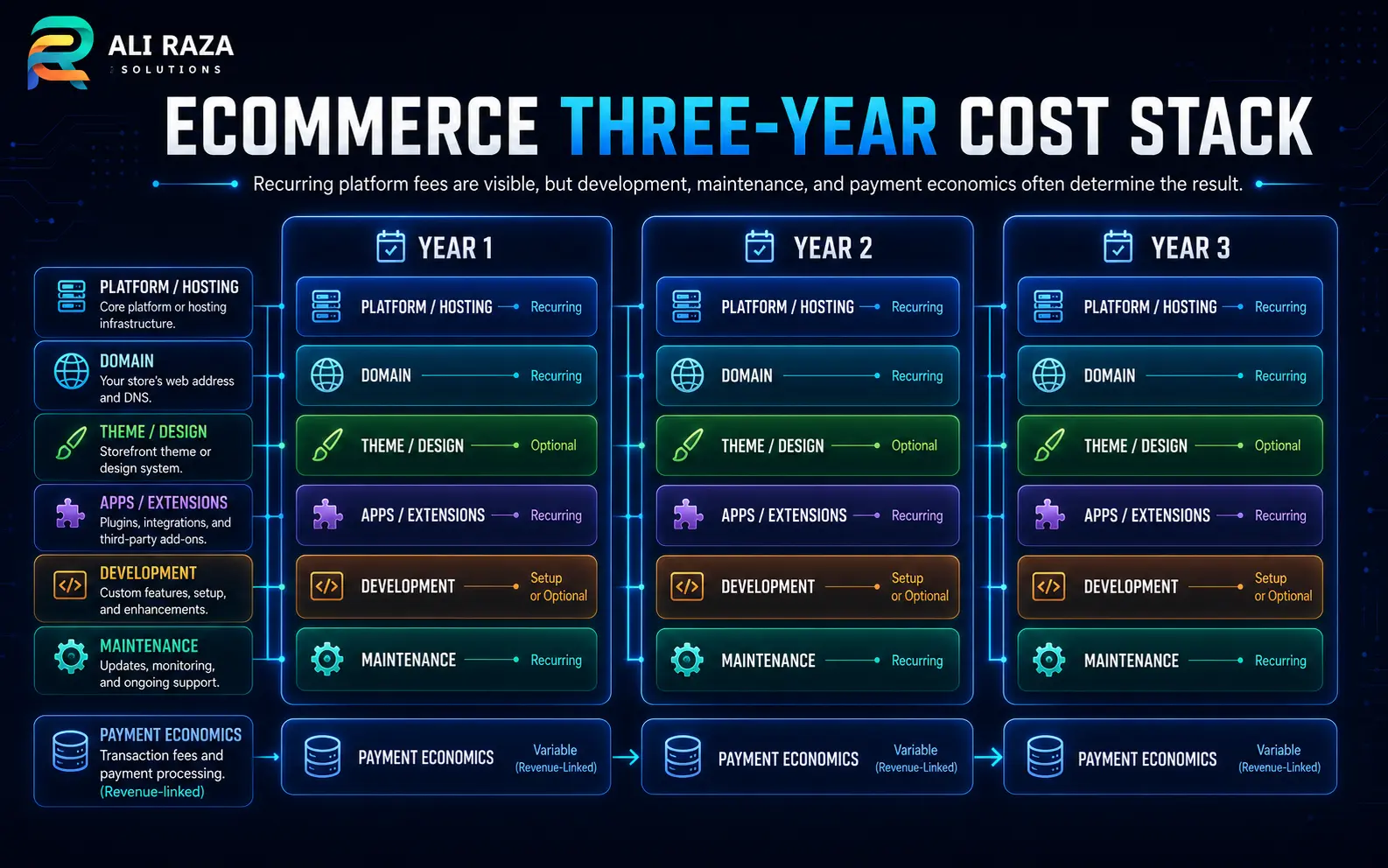
Shopify’s official USD pricing page lists the Basic plan at $29 per month when billed yearly, Grow at $79 per month and Advanced at $299 per month. Shopify also states that secure commerce hosting, unlimited bandwidth and a TLS/SSL certificate are included. Prices and payment rates vary by country and billing cycle, so the live Shopify pricing page should be checked for the store’s actual market.
WooCommerce does not charge a core platform subscription. Its official pricing guidance places hosting at approximately $25 to $350 per month for most stores and extensions at approximately $29 to $299 per year each. The practical total therefore depends on the selected host, traffic, required features and support arrangement. Review the current WooCommerce pricing guidance before budgeting.
Shopify cost structure
- Hosted subscription plan
- Domain registration
- Optional premium theme
- Free and paid apps
- Theme development and support
- Payment and possible third-party transaction fees
WooCommerce cost structure
- WordPress hosting
- Domain registration
- Optional premium theme
- Free and paid plugins or extensions
- Development, maintenance and security
- Payment-gateway processing fees
Assumptions Behind the 3-Year Cost Model
Cost comparisons become misleading when one platform receives professional development and the other is treated as a do-it-yourself project. This model applies comparable business expectations to both platforms.
- One online store operating primarily in one market
- A standard physical-product catalog without a custom ERP rebuild
- A professional theme implementation and normal ecommerce configuration
- Several common commercial features, but no enterprise platform tier
- Ongoing technical support rather than relying entirely on the owner
- USD pricing over 36 months with no inflation adjustment
Costs deliberately excluded from the fixed total
- Payment processing and transaction-linked fees
- Advertising, SEO, email campaigns and content production
- Inventory, warehousing, shipping labels and fulfillment
- Sales tax, VAT, duties and accounting
- Product photography, copywriting and data entry
- Major migration, ERP, marketplace or warehouse integrations
These exclusions do not make the costs unimportant. They keep the platform comparison readable and prevent sales volume from being silently assumed. Payment economics are modeled separately below.
The Illustrative Three-Year Cost Model
| Cost item | Shopify Basic | WooCommerce | Model assumption |
|---|---|---|---|
| Platform or hosting | $1,044 | $1,620 | Shopify: $29 × 36 months. WooCommerce: managed hosting at $45 × 36 months. |
| Domain | $60 | $60 | $20 per year for three years. |
| Theme | $350 | $150 | One paid theme or equivalent license allowance. |
| Apps or extensions | $1,800 | $900 | Shopify: $50 per month. WooCommerce: $300 per year. |
| Initial development | $3,000 | $4,500 | Design implementation, catalog setup, payment setup, QA and launch. |
| Maintenance and support | $3,600 | $5,400 | Shopify: $100 per month. WooCommerce: $150 per month. |
| Three-year total | $9,854 | $12,630 | Excludes payment processing and revenue-linked fees. |
Shopify is cheaper in this model because hosting, platform updates and core infrastructure are bundled into the subscription. WooCommerce has a higher build and maintenance allowance because the store owner controls more of the hosting and software stack.
That does not mean WooCommerce development is always more expensive. A business with an existing WordPress team, reusable components and a modest store can reduce both setup and support. Conversely, a heavily customized Shopify theme with many apps can exceed this model quickly.
Year-by-Year Ownership Cost
| Year | Shopify | WooCommerce | Main reason |
|---|---|---|---|
| Year 1 | $5,638 | $7,260 | Initial development and theme work make the launch year the most expensive. |
| Year 2 | $2,108 | $2,685 | Recurring plan or hosting, domain, apps or extensions and support. |
| Year 3 | $2,108 | $2,685 | Same recurring assumptions, with no major redesign or migration. |
| Total | $9,854 | $12,630 | Payment and revenue-linked costs remain outside this table. |
A three-year view matters because a platform with a lower launch quote can have a larger recurring stack. It also reveals the opposite: a higher-quality initial build can reduce future support and app dependency.
Payment Processing Can Change the Winner
Payment costs are often larger than the software subscription. Shopify’s help documentation explains that Shopify Payments rates vary by plan and market. When a store uses an eligible third-party payment provider instead, Shopify can charge an additional plan-specific transaction fee on top of the provider’s processing fee.
WooPayments uses pay-as-you-go pricing with no setup or monthly fee, but exact rates vary by merchant country, customer country, currency and payment method. WooCommerce itself does not add a platform transaction fee, although the selected processor still charges for payments.
Additional three-year platform fee = eligible sales volume × platform transaction-fee rateFor example, a 2% additional platform fee applied to $300,000 of eligible sales over three years would add $6,000. That amount is more than five years of Shopify Basic subscription at the $29 annual-billing rate. The example is arithmetic, not a prediction that every merchant will pay the fee.
Official references: Shopify pricing and billing overview and WooPayments fee documentation.
Apps and Extensions Create the Quiet Recurring Cost
Both platforms can begin with free functionality. Costs rise when the store needs subscriptions, advanced search, reviews, bundles, wholesale pricing, complex shipping, multilingual content, product feeds, returns, loyalty, automation or specialized reporting.
Shopify app economics
The Shopify App Store contains free, free-to-install and paid apps. The important number is not the first app’s price; it is the combined monthly charge after the store has accumulated several operational dependencies.
WooCommerce extension economics
WooCommerce extensions are often billed annually. The store may also use third-party WordPress plugins with different renewal, support and licensing policies.
Audit each paid add-on with three questions: Is the feature still used? Is it available natively now? What would happen to the storefront, checkout or data if the subscription ended?
Maintenance Is a Cost Even When Nobody Sends an Invoice
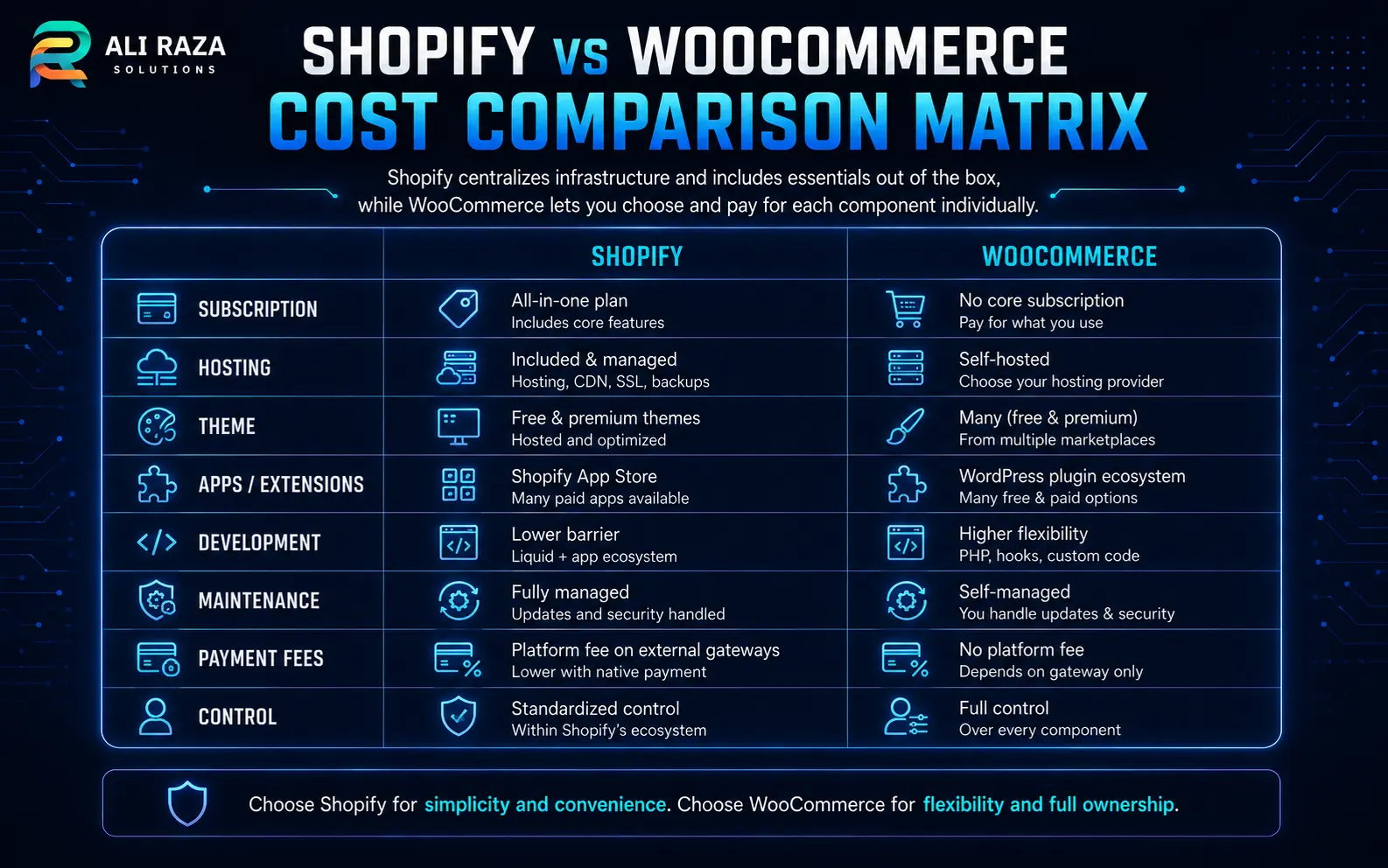
Shopify manages the commerce hosting platform and core infrastructure. A merchant still needs theme changes, app configuration, catalog work, analytics, quality assurance and support when integrations fail.
WooCommerce gives the owner more responsibility for hosting, backups, WordPress core, plugins, themes, security, performance and compatibility. A skilled internal administrator can absorb that work. A business without that capability should budget for professional maintenance rather than treating the time as free.
Updates and compatibility
Test platform, theme, plugin and app changes against product, cart, checkout, email and integrations.
Security and access
Manage accounts, permissions, backups, incident response and third-party access.
Performance
Monitor storefront speed, image weight, scripts, database behavior and checkout reliability.
Operational support
Resolve payment, shipping, tax, order, product feed and integration failures that affect revenue.
Ali Raza Solutions’ web development services cover both Shopify and WooCommerce builds, migrations, integrations and ongoing technical support.
How Growth Changes the Three-Year Cost
Growth does not affect both platforms in the same way. Shopify may require a higher plan for staff, reporting, shipping or payment economics. WooCommerce may need more capable hosting, performance engineering and development as traffic, orders and integrations increase.
| Growth event | Shopify cost effect | WooCommerce cost effect |
|---|---|---|
| More traffic and orders | Hosting remains bundled, but plan and payment economics may justify an upgrade. | Hosting, caching, database and monitoring may need to scale. |
| More staff | Plan capabilities and staff access should be checked. | WordPress roles are flexible, but governance and support workload increase. |
| Subscriptions or memberships | May require an app and recurring fees. | Usually requires paid extensions and maintenance. |
| International markets | Market, currency, tax and payment features may affect plan and fees. | Extensions and custom configuration may be required. |
| ERP, WMS or custom workflow | App, connector or custom API development. | Plugin, connector or custom WordPress development. |
| Major design customization | Theme development within Shopify’s platform constraints. | Broad control, with greater responsibility for implementation quality. |
When Shopify or WooCommerce Usually Costs Less
- The business wants managed hosting and fewer infrastructure decisions.
- The store fits Shopify’s native catalog, checkout and operational model.
- The required features can be covered by a small app stack.
- The team does not have internal WordPress maintenance capability.
- An eligible integrated payment setup avoids additional platform fees.
- The business already has WordPress hosting and technical support.
- The store can use free or low-cost themes and extensions.
- Content, commerce and custom workflows need deep WordPress integration.
- The merchant wants control over hosting, code and data architecture.
- A regional payment gateway would create extra Shopify transaction fees.
The cheaper platform is the one that delivers the required operating model with the fewest expensive workarounds—not necessarily the one with the lower starting price.
Include Migration and Switching Costs Before Committing
A platform decision should include the cost of leaving. Product data may transfer relatively cleanly, while customer accounts, passwords, order history, subscriptions, gift cards, reviews, redirects, structured data and app-specific information can require specialized work.
- Document which system owns products, customers, orders and content.
- Confirm export formats before relying on a third-party app.
- Preserve URLs or create a complete redirect plan for SEO.
- Test payment tokens, subscriptions and customer account behavior.
- Budget for parallel operation, QA and post-launch support.
A three-year saving can disappear if the chosen platform needs an early rebuild. Platform fit should therefore be based on the likely business model at the end of the three years, not only the launch requirements.
A Practical Shopify vs WooCommerce Decision Framework
| Decision question | Shopify advantage | WooCommerce advantage |
|---|---|---|
| Who will manage hosting and updates? | Platform-managed infrastructure | Owner-selected infrastructure and process |
| How custom is the content and workflow? | Strong when requirements fit the platform and app ecosystem | Broad WordPress and code-level control |
| Which payment providers are available? | Integrated Shopify Payments can simplify fees and operations | Gateway choice without a WooCommerce platform transaction fee |
| How many paid add-ons are required? | Native features can keep the stack simple | Free and paid plugin choice can reduce or increase cost |
| What technical capability exists internally? | Lower infrastructure burden | Lower cost potential with competent WordPress capability |
| How important is infrastructure portability? | Hosted SaaS convenience | Choice of host and greater control of the application stack |
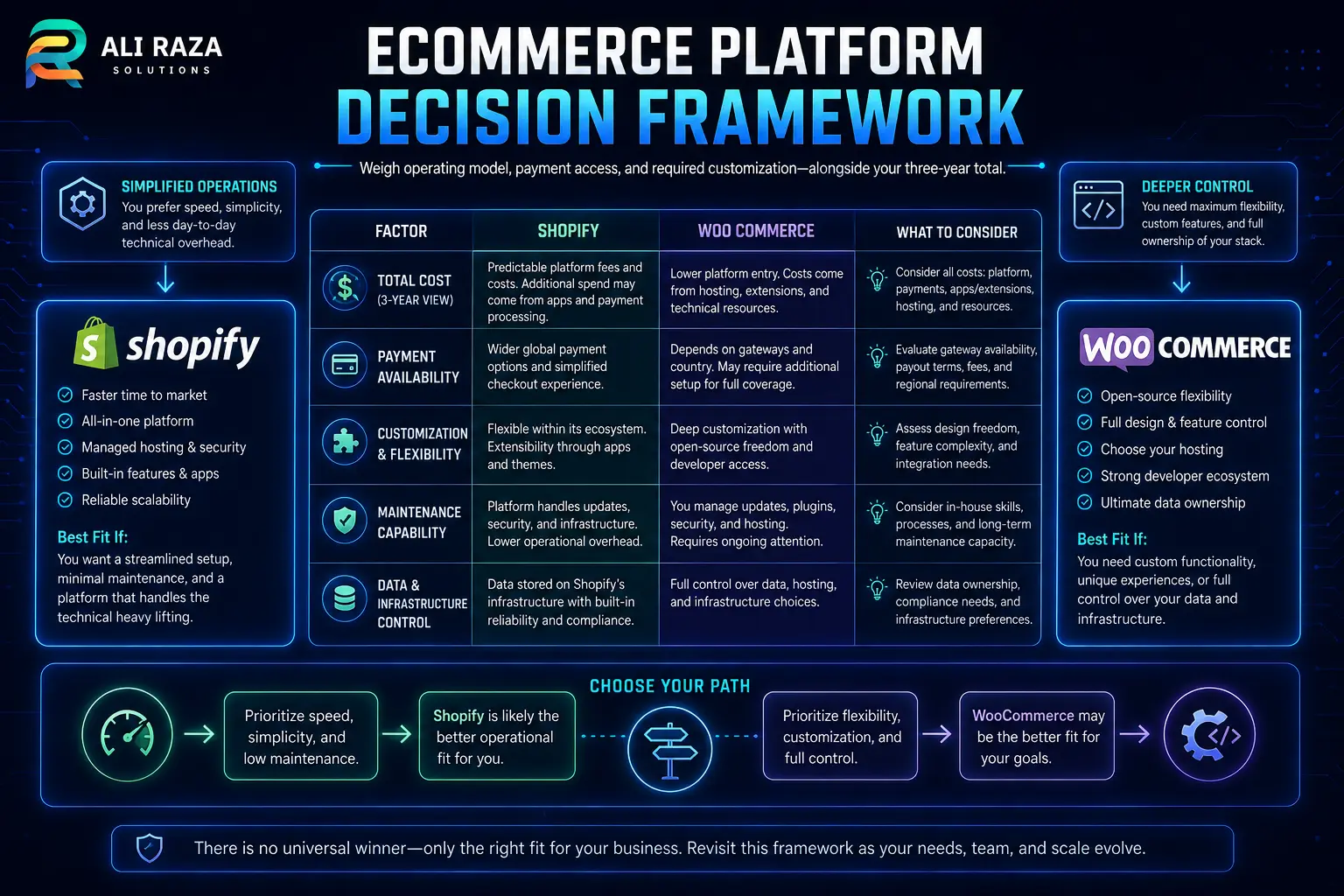
Give both platforms the same requirements
- Expected products, variants, orders and traffic
- Required countries, currencies and payment providers
- Shipping, tax, returns and inventory workflows
- Subscriptions, wholesale, memberships or marketplace needs
- ERP, CRM, accounting and fulfillment integrations
- Internal staff capability and desired support level
- Data migration and SEO redirect requirements
Then ask for launch cost, recurring licenses, support, infrastructure, payment charges and likely upgrade triggers as separate lines.
Frequently Asked Questions About Shopify vs WooCommerce Cost
These answers clarify the assumptions and cost decisions behind a three-year platform comparison.
Is Shopify or WooCommerce cheaper over three years?
It depends on the store. WooCommerce can be cheaper for a technically capable owner using modest hosting and few paid extensions. Shopify is often cheaper for a small business that values managed hosting and lower maintenance. The result changes when custom development, apps, support and payment-provider fees are included.
What is included in the three-year cost comparison?
The illustrative model includes platform or hosting, domain, theme, apps or extensions, initial development and ongoing support. It excludes payment processing, advertising, inventory, shipping, tax, content production and staff time because those costs vary substantially by business.
Does WooCommerce charge a monthly platform fee?
The WooCommerce core plugin does not charge a platform subscription. A working store still needs WordPress hosting, a domain, maintenance and any paid themes or extensions required by the project.
Does Shopify include hosting and SSL?
Yes. Shopify states that secure commerce hosting, unlimited bandwidth and a TLS or SSL certificate for connected domains are included with its plans. The subscription does not automatically include every app, premium theme, custom feature or development service.
Why are payment processing fees excluded from the main total?
Processing costs depend on country, payment method, order count, currency and sales volume. They can be larger than the platform subscription, so the article gives a separate formula and shows why the selected gateway must be evaluated before choosing a platform.
Can Shopify become more expensive because of apps?
Yes. Many stores add paid apps for subscriptions, search, reviews, bundles, international selling or operations. Each app may look inexpensive alone, but recurring charges can materially change the three-year total.
Can WooCommerce become more expensive because of maintenance?
Yes. WooCommerce gives the owner more control over hosting and code, but updates, backups, security, performance and compatibility still require time or professional support. Complex integrations can make maintenance the largest ownership cost.
Which platform is better for a custom ecommerce store?
WooCommerce usually offers deeper control over WordPress, data and custom workflows. Shopify can still support substantial customization, but the best choice depends on checkout requirements, integrations, staff capability, market, payment options and the cost of maintaining custom work.
Should a growing store choose Shopify Basic, Grow or Advanced?
Choose the plan by required features, staff access, reporting and payment economics rather than store age alone. Shopify notes that plan prices and transaction rates vary by market, so compare the live pricing page and calculate the effect of your expected sales volume.

About Ali Raza Solutions
Ali Raza Solutions builds Shopify, WooCommerce and custom ecommerce websites, including platform planning, design, development, migration, payment integration and post-launch support.
Pricing is provided for planning and comparison, not as a vendor quote. Platform fees, exchange rates, taxes, app prices, hosting requirements and payment rates can change. Confirm all costs for the merchant’s country, billing cycle, sales volume and selected providers before committing.