
Working With Us Clients: How We Handle the 10-Hour Gap
If you’re a US or UK small business owner, working with us clients usually walk in with two fears: bad communication and a contractor who disappears. Fair concerns — we hear them from almost every client before they sign on. Here’s exactly how it works, hour by hour, so you can decide for yourself instead of taking our word for it.
The Time Zone Gap, and How We Cover It
We’re based in Lahore, Pakistan — GMT+5, roughly a 10-hour gap from US Eastern time and a 5-hour gap from the UK. That gap is real, and pretending otherwise would be dishonest. What matters is how much of it actually overlaps with your working day.
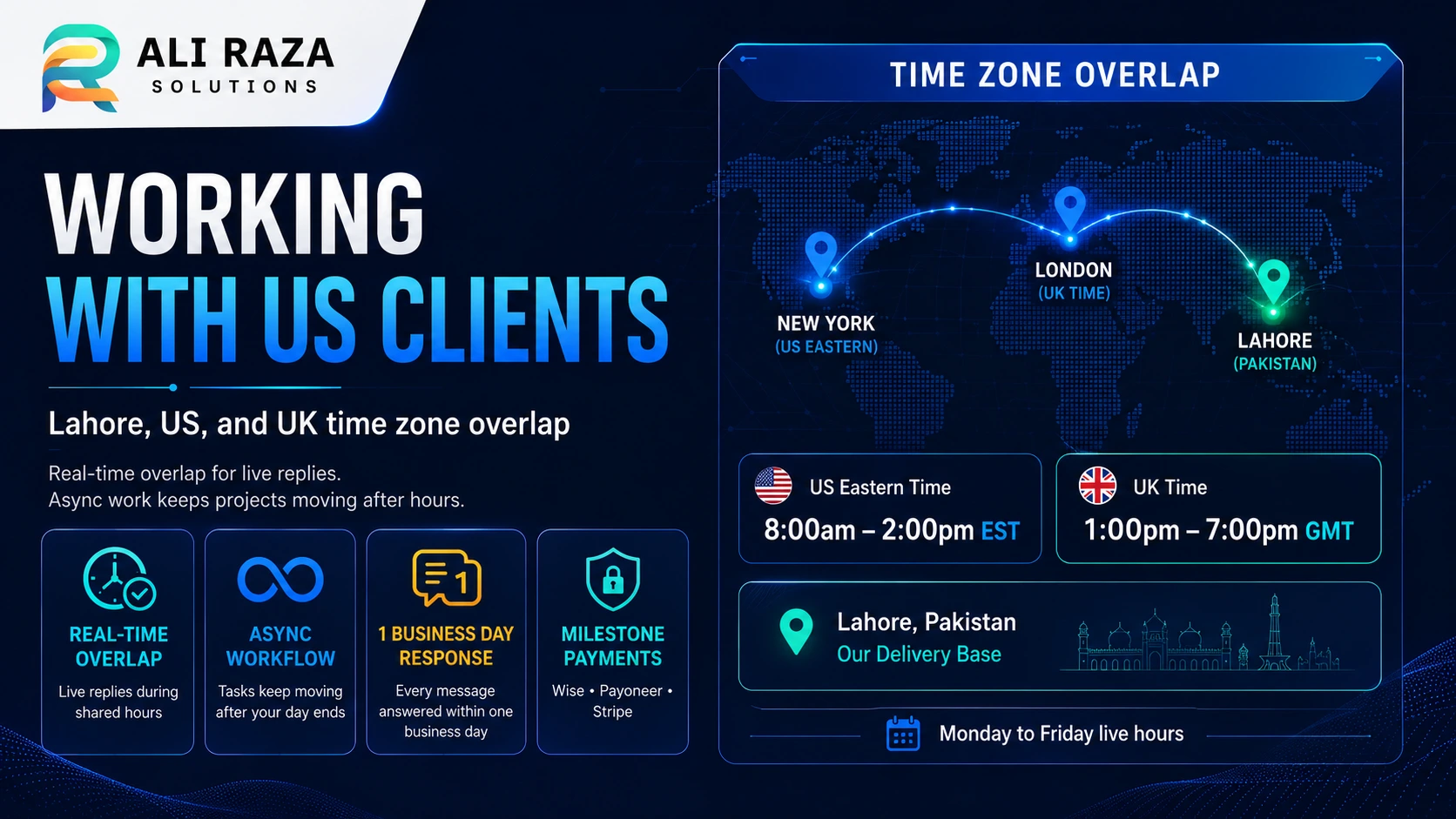
Those are our live hours, Monday to Friday — the window where working with us clients can expect a real-time reply, not a next-morning one. Outside that window, the work doesn’t stop; it just moves to async.
Async isn’t a downgrade if it’s used correctly. A well-written task or a recorded walkthrough doesn’t need you online to keep moving — it only breaks down when the other side goes quiet for days at a time. That’s the actual failure mode people are worried about when they ask about offshore teams, and it’s a management problem, not a time zone problem. Plenty of well-run remote teams operate across wider gaps than ours; GitLab’s public playbook on asynchronous work is a good reference if you want to see the pattern documented by a company that’s operated fully remote for years.
What Working With Us Clients Get, Week to Week
In practice, most weeks look less like “waiting for Pakistan to wake up” and more like a normal remote working relationship with one extra handoff point. You send requests or feedback during your day; by the time you’re back online, there’s usually progress, a question, or a finished task waiting — not silence.
Every message gets answered within one business day, and almost always faster than that during the live-hours overlap above.
Tools We Use to Keep Communication Tight
This section needs your real tool names before publishing — task tracking, day-to-day messaging, video calls, and file/demo sharing. Send them and this becomes: “We run tasks in [tool], talk day to day in [tool], hop on video via [tool], and share progress demos through [tool].” Right now it’s a placeholder, not a claim about how you actually work.
What Happens While You Sleep
Work doesn’t pause just because your evening starts. Tasks already scoped and approved keep moving during our live hours, so working with us clients waking up often find a day’s worth of progress waiting, not a blank inbox. Anything that needs your input queues up as a specific question rather than an open-ended status update — the goal is for you to spend two minutes unblocking us, not twenty minutes figuring out what we need.
Escalation Path When Something’s Urgent
Same as above — I don’t know if there’s a real emergency contact channel outside live hours (a phone number, a WhatsApp line, an on-call rotation) or whether urgent issues simply wait for the next live-hours window. Tell me which one is actually true and this section gets the real answer instead of a placeholder.
How This Compares to Hiring Locally
The honest comparison isn’t “offshore vs. perfect.” It’s offshore vs. what a small business can actually afford locally. A US or UK developer with equivalent experience typically costs 3 to 5 times what we charge for the same scope of work — not because offshore talent is worse, but because the cost of living and market rate are genuinely different in Lahore than in New York or London.
That gap doesn’t mean cutting corners on quality. It means the same senior-level work costs less, and the savings show up as either a lower price or a bigger scope for the same budget. Working with us clients only run into trouble when the team on the other end treats the time zone gap as an excuse instead of something to actively manage — which is the entire point of publishing the live hours, response times, and escalation expectations on this page instead of leaving them vague.
If you’ve been burned by an offshore contractor before, the pattern is usually the same: no fixed hours, slow responses, and a project that quietly stalls. None of that is inherent to offshore work — it’s what happens when nobody commits to specific hours or a specific response time in writing, which is exactly what the sections above do.
If you’re an agency specifically looking for overflow capacity rather than a one-off project, our white label WordPress development page covers the NDA, rate card, and “we never contact your client” guarantee in detail.
Payments, Contracts, and Trust — What Working With Us Clients Can Count On
The practical questions behind “can I trust an offshore team” usually come down to money and paperwork — the same two things working with us clients ask about before signing anything. Here’s where we stand on both:
None of this replaces a real relationship — it’s just the baseline that makes working with us clients report feeling less like a leap of faith and more like hiring an in-house web development team that happens to sit in a different time zone.
Frequently Asked Questions
Straight answers to what working with us clients ask most before their first project starts.
We’re based in Lahore, Pakistan (GMT+5). Our live hours are 8:00am–2:00pm EST and 1:00pm–7:00pm GMT, Monday to Friday, so there’s a real overlap window with both US and UK business hours.
Every message gets answered within one business day, usually much sooner during our live hours.
Standard issues wait for the next live-hours window and get picked up first thing. For true emergencies, ask your project contact about the fastest way to reach the team.
Yes — payments are milestone-based, so you approve the work before you pay for it. We’re paid via Wise, Payoneer, or Stripe. No crypto, no cash transfers.
Yes, on request, before any code or credentials change hands.
See It In Practice, Not Just on Paper
The best way to evaluate working with us clients is a small first project, not a long contract. Start with a free site audit and see how we communicate before you commit to anything bigger.
Get a Free Site Audit