US Agency vs Offshore Team Cost: 7 Critical Ways to Avoid Costly Surprises
A practical cost model for comparing local agencies, UK providers, offshore development teams and hybrid delivery without reducing the decision to one hourly rate.
Published: August 6, 2026 · Approximate reading time: 13 minutes
See the cost breakdown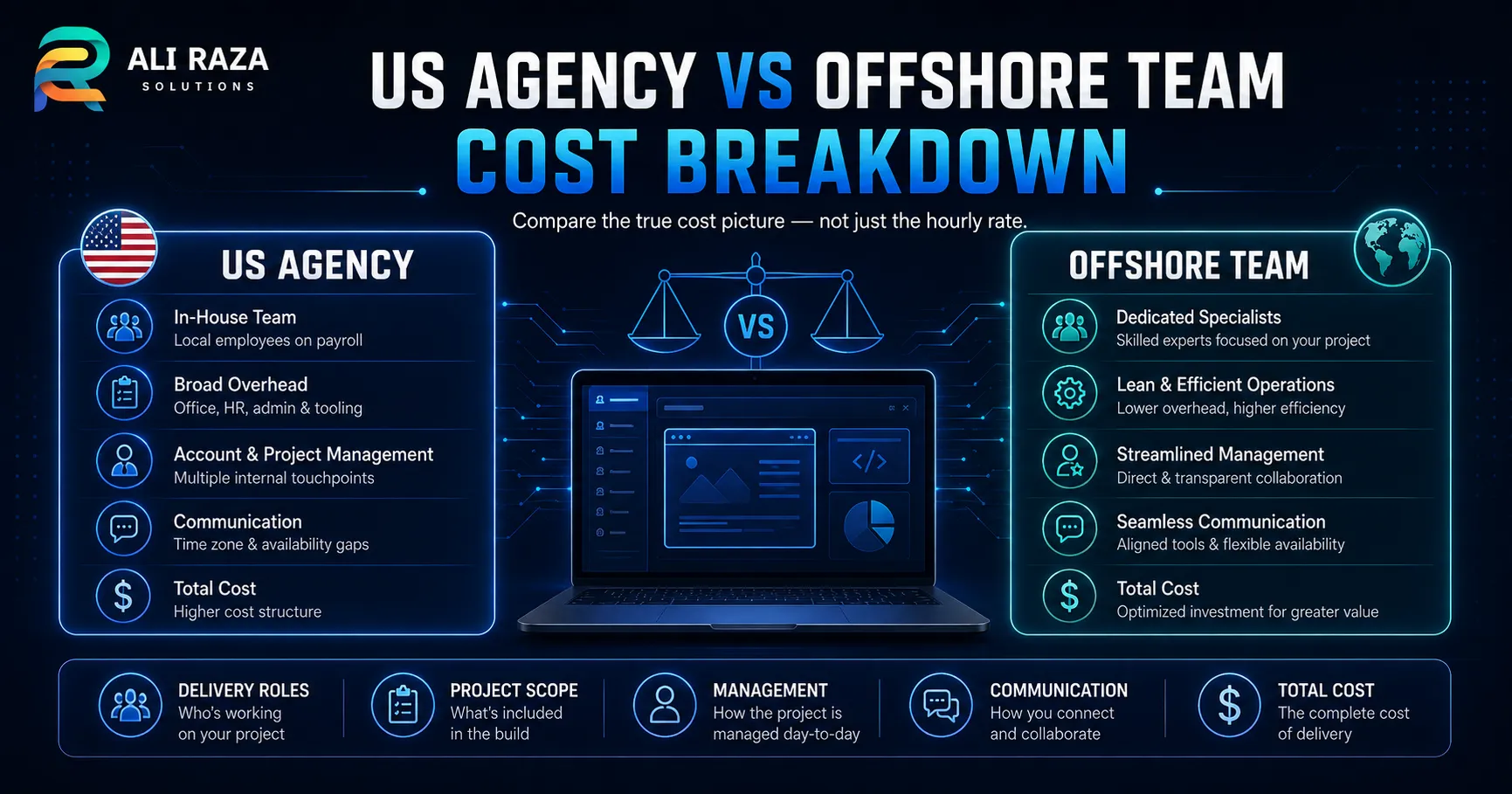
US agency vs offshore team cost is not simply a comparison between one high hourly rate and one low hourly rate. The financially safer choice is the delivery model that completes the agreed scope with enough strategy, project management, quality assurance, documentation and post-launch support.
An offshore team will often quote a lower rate because labor and operating costs differ by market. A US or UK agency may charge more while including discovery, workshops, account management and local overlap. Either model can become expensive when the scope is unclear, decisions are slow or rework is hidden outside the original estimate.
What US Agency vs Offshore Team Cost Actually Includes
A useful comparison starts with the same written scope. Ask each provider to price discovery, user experience, visual design, frontend work, backend work, integrations, migration, quality assurance, deployment, documentation and warranty support. If one proposal includes these items and another excludes them, the headline totals are not comparable.
Discovery and scope
Requirements, user journeys, technical constraints, content responsibilities, integrations and acceptance criteria.
Design and content
Information architecture, wireframes, visual design, responsive states, copy, images and approval rounds.
Development and QA
Frontend, backend, CMS configuration, testing, accessibility checks, security work and performance optimization.
Launch and ownership
Deployment, redirects, analytics, training, documentation, warranty terms, maintenance and repository handover.
The first rule of a fair US agency vs offshore team cost review is therefore simple: normalize the deliverables before comparing the money.
Current Web-Development Rate Benchmarks
Marketplace data provides context, not a quote. Clutch’s June 2026 pricing guide says shortlisted web-design companies commonly charge about $100–$149 per hour, while its web-development guide reports that many listed development companies charge $25–$49 per hour. Its UK directories show a wide spread, with many agencies listed across several rate bands rather than one national price.
A practical US agency vs offshore team cost comparison treats these figures as context rather than a substitute for a written estimate.
These ranges overlap different company sizes, regions, specialisms and service mixes. Use the Clutch web-design pricing guide and Clutch web-development pricing guide as directional benchmarks, then request a project-specific breakdown.
The US agency vs offshore team cost gap may partly reflect different salary and operating structures, but it does not measure delivery quality by itself.
Labor data also explains only part of agency pricing. The US Bureau of Labor Statistics reported May 2024 median annual wages of $90,930 for web developers and $98,090 for web and digital-interface designers. An agency rate must also cover non-billable time, management, software, benefits, sales, equipment and business risk. See the current BLS occupational profile.
Do not treat a directory rate as a guaranteed regional average. Seniority, technology, compliance, design depth and included management can move a real proposal far outside a broad band.
Illustrative Cost Scenarios
In a US agency vs offshore team cost model, the hourly band matters only after the workload and included roles are normalized.
The following arithmetic shows how hourly bands affect a fixed amount of work. It is not a quotation, forecast or promise. The same number of hours may also deliver different outcomes when discovery, senior review or testing quality changes.
| Illustrative scope | Estimated hours | US agency model at $100–$149/hr | Offshore model at $25–$49/hr |
|---|---|---|---|
| Marketing website | 300 | $30,000–$44,700 | $7,500–$14,700 |
| Ecommerce or complex rebuild | 700 | $70,000–$104,300 | $17,500–$34,300 |
| Custom platform or substantial MVP | 1,500 | $150,000–$223,500 | $37,500–$73,500 |
The table makes the apparent US agency vs offshore team cost gap easy to see, but it does not show whether both teams estimated the same scope, assigned comparable seniority or included the same number of review cycles.
The True-Cost Formula
Total delivery cost = billed work + internal management + tools + rework + delay cost + post-launch support
A low supplier rate can still produce a high total when internal managers spend many hours rewriting tickets, resolving misunderstandings or coordinating fragmented vendors. A higher rate can also be wasteful when the agency adds layers that the project does not need.
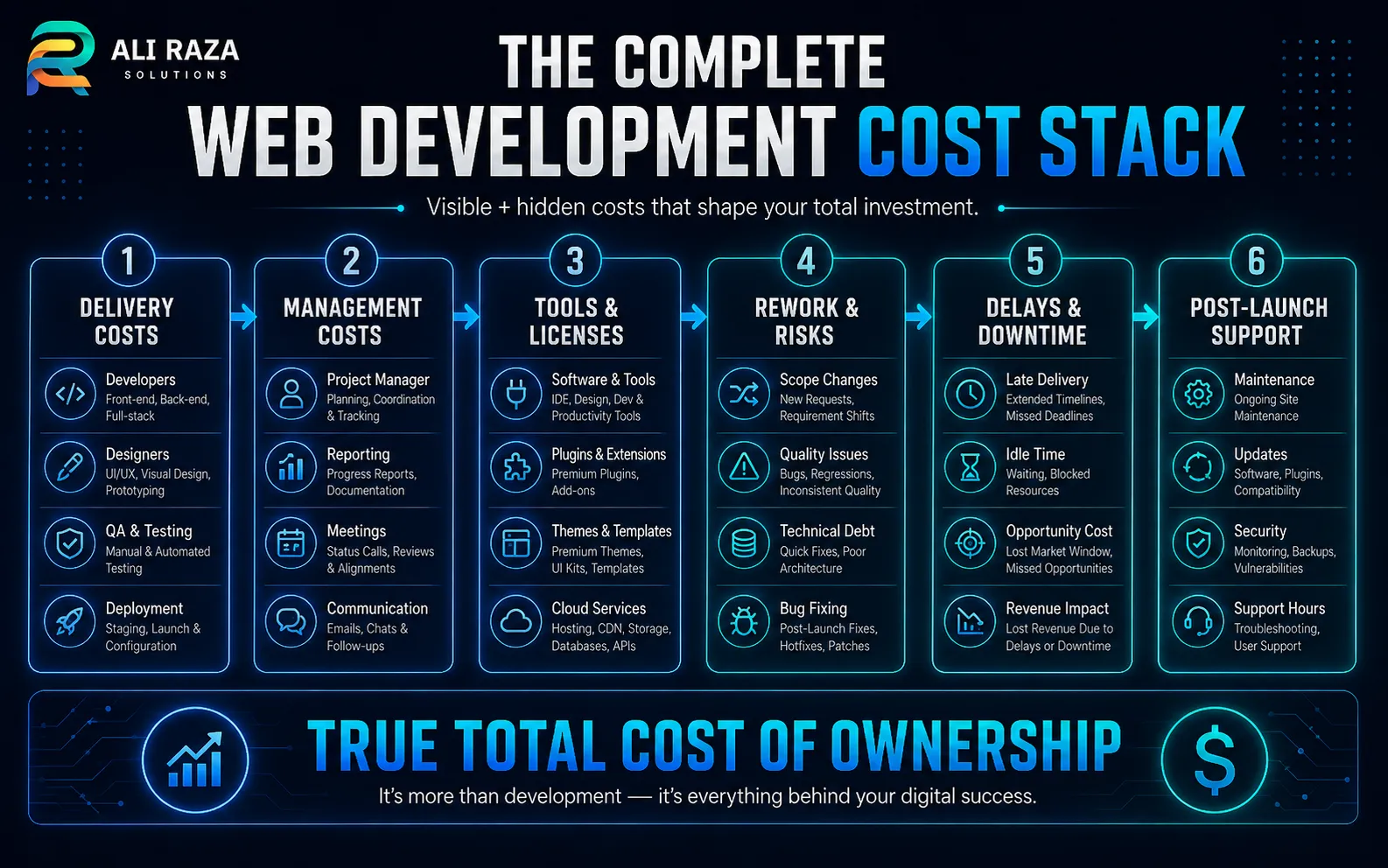
For each proposal, estimate client-side hours as well as supplier hours. Multiply internal time by a realistic loaded cost, add likely software and infrastructure charges, and identify who pays for defects, changes and delayed decisions. This converts US agency vs offshore team cost from a sales comparison into a business case.
When a US or UK Agency May Justify the Higher Rate
The US agency vs offshore team cost premium may be justified when local access removes material delivery risk.
A local agency can be valuable when the work requires frequent workshops, stakeholder interviews, brand strategy, regulated-sector input or substantial timezone overlap. One contract may also combine product strategy, content, design, development and launch management.
- Stakeholder access: easier scheduling for workshops and executive reviews.
- Integrated strategy: brand, user experience and technology may sit under one delivery lead.
- Procurement familiarity: contracts, insurance and vendor onboarding may align with local expectations.
- Escalation: governance and dispute routes can be simpler when the buyer and supplier share a jurisdiction.
These are possible advantages rather than guarantees. A local address does not prove that the work is senior, in-house or well managed. Ask who will perform each role and whether subcontractors are involved before accepting a higher US agency vs offshore team cost.
When an Offshore Development Team Creates Better Value
The US agency vs offshore team cost difference can fund more delivery capacity when governance and communication are strong.
An offshore team can stretch a fixed budget across more engineering, testing, documentation or ongoing improvement. It can also give a company access to specialist frameworks or a dedicated remote development team that would be difficult to hire locally.
- Team capacity: the same budget may fund several complementary roles rather than one generalist.
- Flexible engagement: dedicated-team, milestone or retained-support arrangements can match changing workloads.
- Extended coverage: planned timezone differences can create useful handoffs across the working day.
- Longer runway: lower delivery costs may preserve budget for QA, content, analytics and maintenance.
Location should never be used as a proxy for quality. The strongest offshore development providers use version control, staging environments, peer review, documented QA and direct communication. Ali Raza Solutions describes its web-development process from discovery through design, development, QA, launch and handover.
US Agency, UK Agency, Offshore Team or Hybrid?
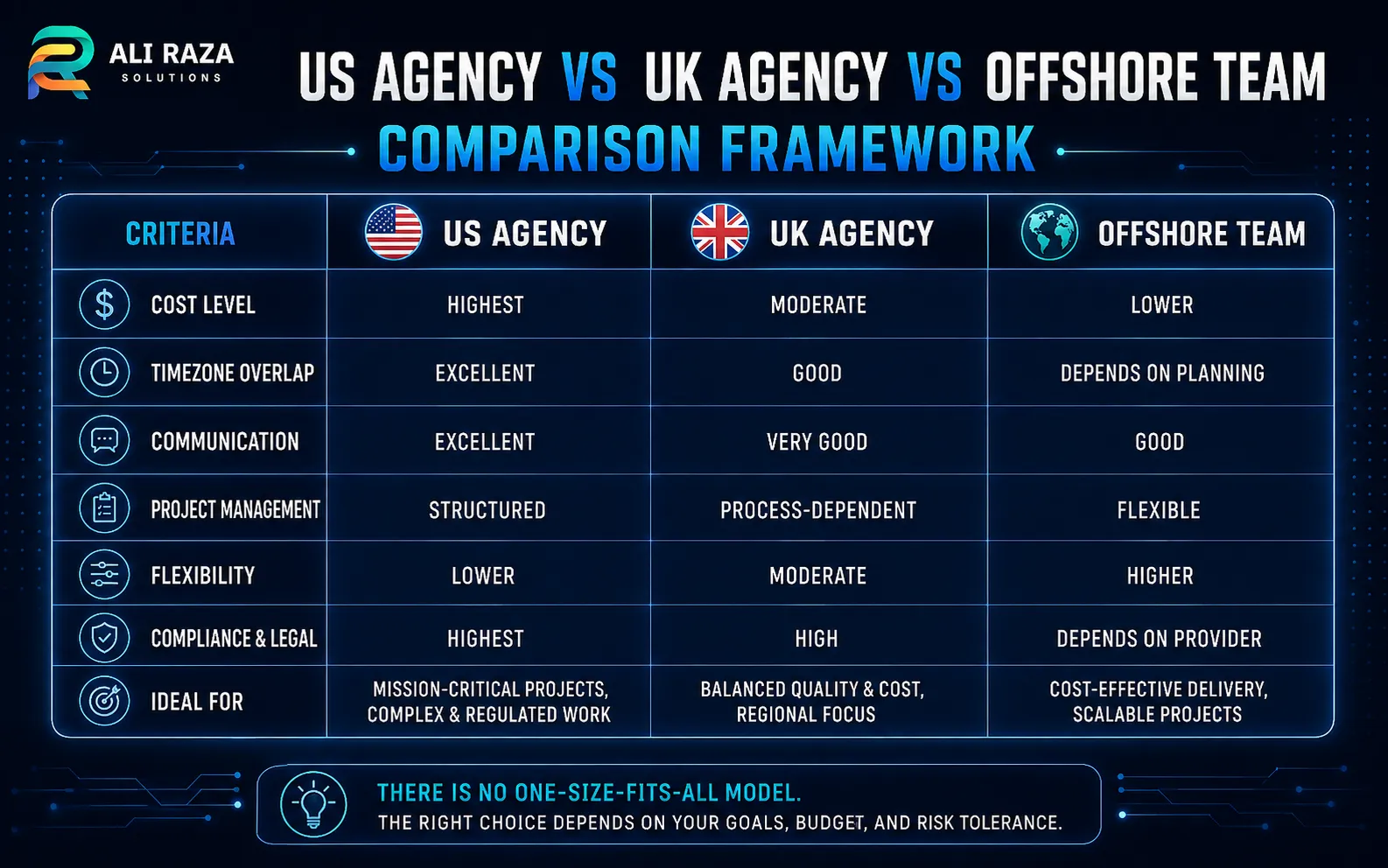
A useful US agency vs offshore team cost decision also considers who owns strategy and delivery. The hybrid model—local product leadership with offshore design and engineering—can combine overlap with cost efficiency, but only when responsibilities are explicit.
| Criterion | US or UK agency | Offshore team | Hybrid model |
|---|---|---|---|
| Hourly structure | Often higher, with broader overhead and service layers | Often lower, depending on location and seniority | Mixed local leadership and offshore delivery |
| Timezone overlap | Usually high for local buyers | Must be designed into the workflow | Local lead can bridge delivery windows |
| Client management | May be included through account or project management | Varies from fully managed to client-led | Requires clear authority between both sides |
| Scaling capacity | Depends on agency bench and scheduling | Can be flexible with a dedicated team | Can scale delivery while retaining local governance |
| Compliance work | May offer easier access to local specialists | Requires documented contractual and data controls | Local advisers can guide an offshore implementation |
| Best fit | High-touch strategy or local procurement | Well-scoped delivery and long-term capacity | Complex products needing both governance and scale |
Questions to Ask Every Development Provider
Send the same questions to every bidder. Their answers reveal more about likely US agency vs offshore team cost than a rate card viewed in isolation.
- Who will perform strategy, design, development, QA and project management?
- Which roles and meetings are included in the quoted rate or fixed price?
- What assumptions, exclusions and client responsibilities affect the estimate?
- How are changes estimated, approved and documented?
- Who owns the source code, design files, accounts and licenses?
- Which testing environments, browsers and devices are included?
- Are subcontractors used, and where can they access data?
- What warranty, maintenance and response terms apply after launch?
- What happens if a key team member changes?
- Which handover documents and access-removal steps are included?
How to Choose the Financially Safer Model
Use the US agency vs offshore team cost comparison to expose trade-offs, not to select the lowest number automatically.
Start with risk, not rate. A predictable brochure site with a detailed specification may work well with a capable offshore team. A politically complex redesign involving several departments may benefit from local workshops. A custom product may justify a hybrid model with local product ownership and remote engineering capacity.
Normalize the scope
Give each provider the same deliverables, assumptions, acceptance criteria and support requirements.
Model total cost
Add internal management, tools, likely rework, delay exposure and post-launch ownership.
Test the working relationship
Use a paid discovery phase, technical review or small milestone before committing to the entire build.
Protect the exit
Confirm repository control, documentation, credentials, licenses, data return and handover before work begins.
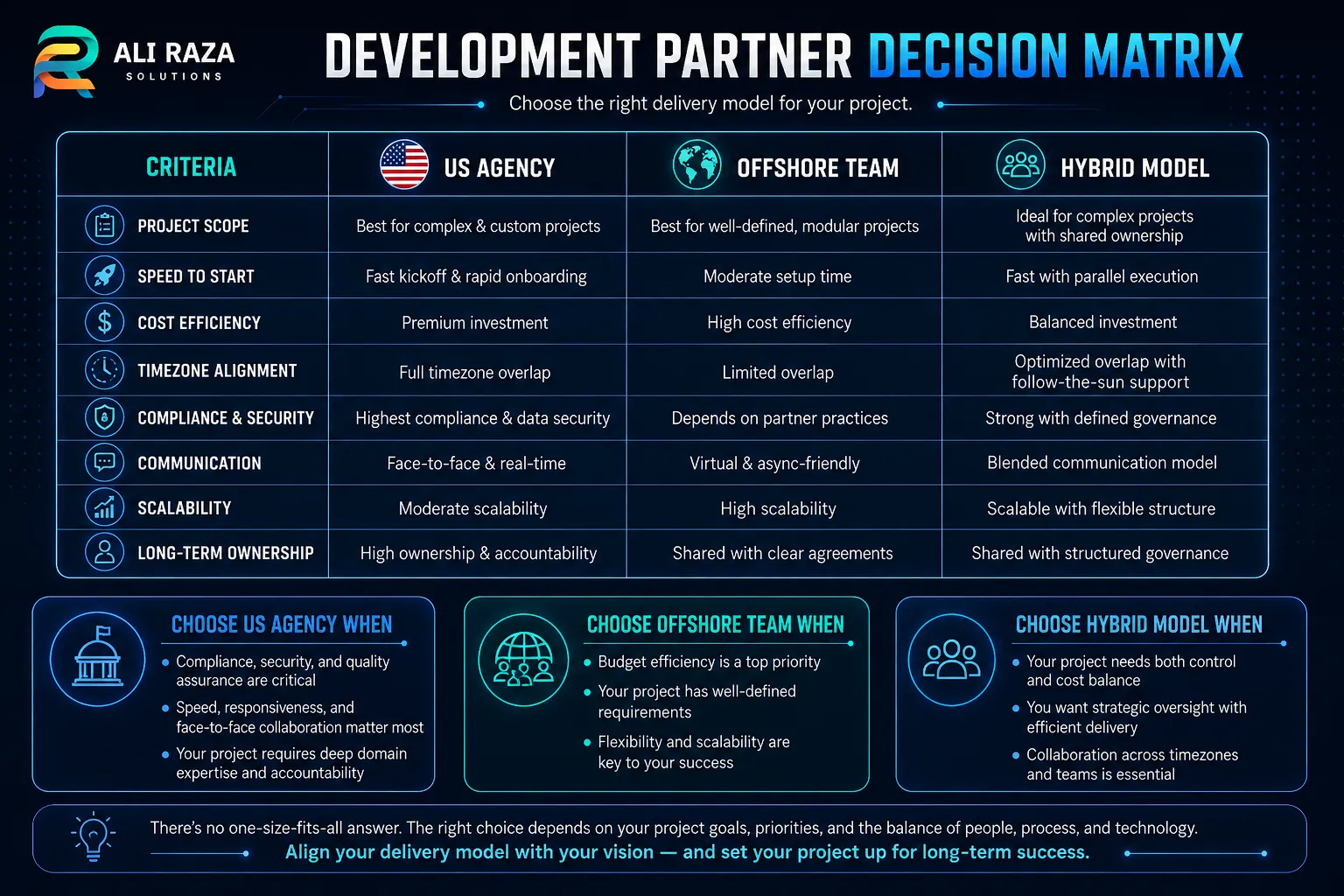
There is no universal winner in the US agency vs offshore team cost comparison. The best choice is the provider that makes scope, ownership, communication, quality controls and long-term costs visible before the contract is signed.
Frequently Asked Questions About US Agency and Offshore Development Costs
These answers clarify the most common pricing and procurement questions.
Is an offshore development team always cheaper?
No. A US agency vs offshore team cost comparison can show a lower supplier rate but a higher total after internal management, rework, unclear scope, delays or missing support. Compare the complete delivery model rather than the invoice rate alone.
How much does a US web agency charge per hour?
Rates vary widely. Clutch’s June 2026 web-design pricing guide says shortlisted firms commonly charge about $100–$149 per hour, while individual proposals may fall outside that band based on services, location and expertise.
How much can offshore web development cost?
There is no single offshore rate. Clutch’s web-development guide reports that many listed companies charge $25–$49 per hour, but geography, seniority, technology and management can place a provider below or above that range.
Are UK web agencies cheaper than US agencies?
Not necessarily. UK directory listings span several hourly bands, and London or specialist agencies may price similarly to US firms. Compare scope and currency at the quotation date instead of assuming a national discount.
What hidden costs should be added to an offshore quote?
Add client-side project management, tools, infrastructure, communication overhead, likely rework, delay exposure, currency or payment charges, security review, maintenance and handover work where these are not included.
How much timezone overlap is necessary?
The answer depends on delivery style. A stable, documented backlog may need a short daily overlap, while discovery, incident response or rapid product iteration may need several shared hours and named decision owners.
Should a startup use a dedicated remote development team?
It can be a good fit when the startup has clear product ownership, a prioritized backlog and enough management capacity. A startup without those controls may benefit from a managed discovery or hybrid engagement first.
How can a business protect its source code and data?
Keep repositories and key accounts under business control, grant least-privilege access, define intellectual-property and confidentiality terms, record subcontractors, require backups and documentation, and remove access at handover.
Is fixed-price or hourly billing better?
Billing structure changes how US agency vs offshore team cost is controlled. Fixed price suits stable scope and clear acceptance criteria, while hourly or dedicated-team billing suits evolving products. In either case, define assumptions, reporting, approval rules and what happens when scope changes.
When does a hybrid delivery model make sense?
A hybrid model can work when the project needs local product leadership, stakeholder access or compliance input alongside flexible remote engineering. It needs one accountable owner and clear boundaries between teams.

About Ali Raza Solutions
Ali Raza Solutions provides WordPress, Shopify and custom web development, along with SEO and paid-media services for businesses in Pakistan, the United States, the United Kingdom and other international markets.
Pricing examples are illustrative benchmarks, not quotations or guaranteed savings. Final costs depend on scope, technology, seniority, timeline, compliance requirements, taxes, exchange rates and included services. Obtain qualified legal, tax, security or privacy advice where appropriate.