UK Tradesman Website: 9 Essential Features for More Local Leads
A practical website guide for UK plumbers, electricians, builders, roofers, decorators, landscapers and other trade businesses that want clearer local enquiries.
Published: · Approximate reading time: 12 minutes
See the essential features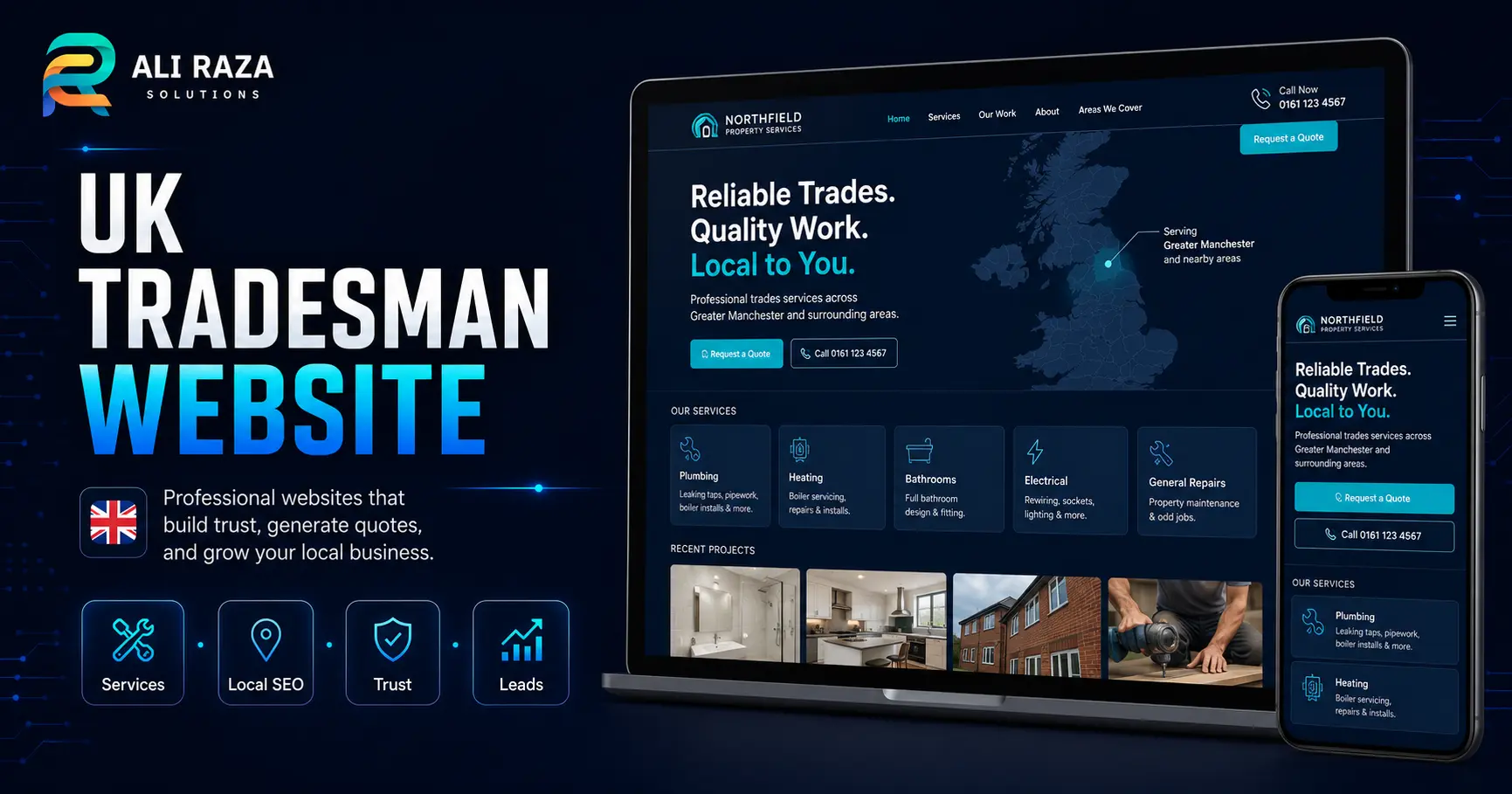
UK Tradesman Website: The Short Answer
A strong UK tradesman website should quickly answer five questions: what work you do, where you work, why a customer should trust you, what relevant work you can show, and how someone can request a quote or call. The site does not need unnecessary complexity; it needs a clear mobile journey from local search or referral to the right service page and then to a sensible enquiry action.
For a UK tradesman website, the website should support your wider local presence rather than trying to replace it. Google Business Profile can help customers discover a trade business locally, while the website gives you more room to explain services, service areas, project examples, qualifications, contact details and the customer process.
9 Essential Features Every UK Tradesman Website Needs
For a UK tradesman website, the best feature list is built around real customer decisions rather than generic agency trends. These nine elements cover the core journey from local discovery to enquiry.
Clear service proposition
State the trade, main services and primary location or coverage area near the top of the page so visitors know they are in the right place.
Mobile-first enquiries
Use a visible tap-to-call action and a short quote form that does not force a customer through unnecessary fields before first contact.
Dedicated service pages
Create useful pages for distinct services when customers search for or evaluate them differently.
Real service-area information
Explain where the business genuinely works without duplicating the same thin page across dozens of towns.
Project evidence
Show genuine examples of completed work where available, with useful context about the type of job rather than unexplained image grids.
Trust information
Display real qualifications, accreditations, insurance details or memberships only when the business can substantiate them.
Accurate reviews
Use testimonials and review excerpts honestly. Do not invent star ratings, review counts or customer outcomes.
Fast quote workflow
Let customers share the service, postcode or area, project summary and preferred contact method without creating a long application form.
Local SEO foundations
Use crawlable service pages, sensible internal links, descriptive titles, accurate business information and technically sound indexing settings.
Make the Homepage Explain What You Do and Where
A UK tradesman website homepage should not make customers search for basic information. The hero area can state the main trade or specialism, the core geographic area and one primary action such as “Request a Quote” or “Call Now”.
Below that, introduce the main services, selected project evidence, a short trust section, service-area information and a clear contact path. A visitor arriving from a referral may know the company name but not the full range of services, while a visitor arriving from search may know the service but still need proof that you cover their location.
Build Useful Service Pages, Not One Giant List
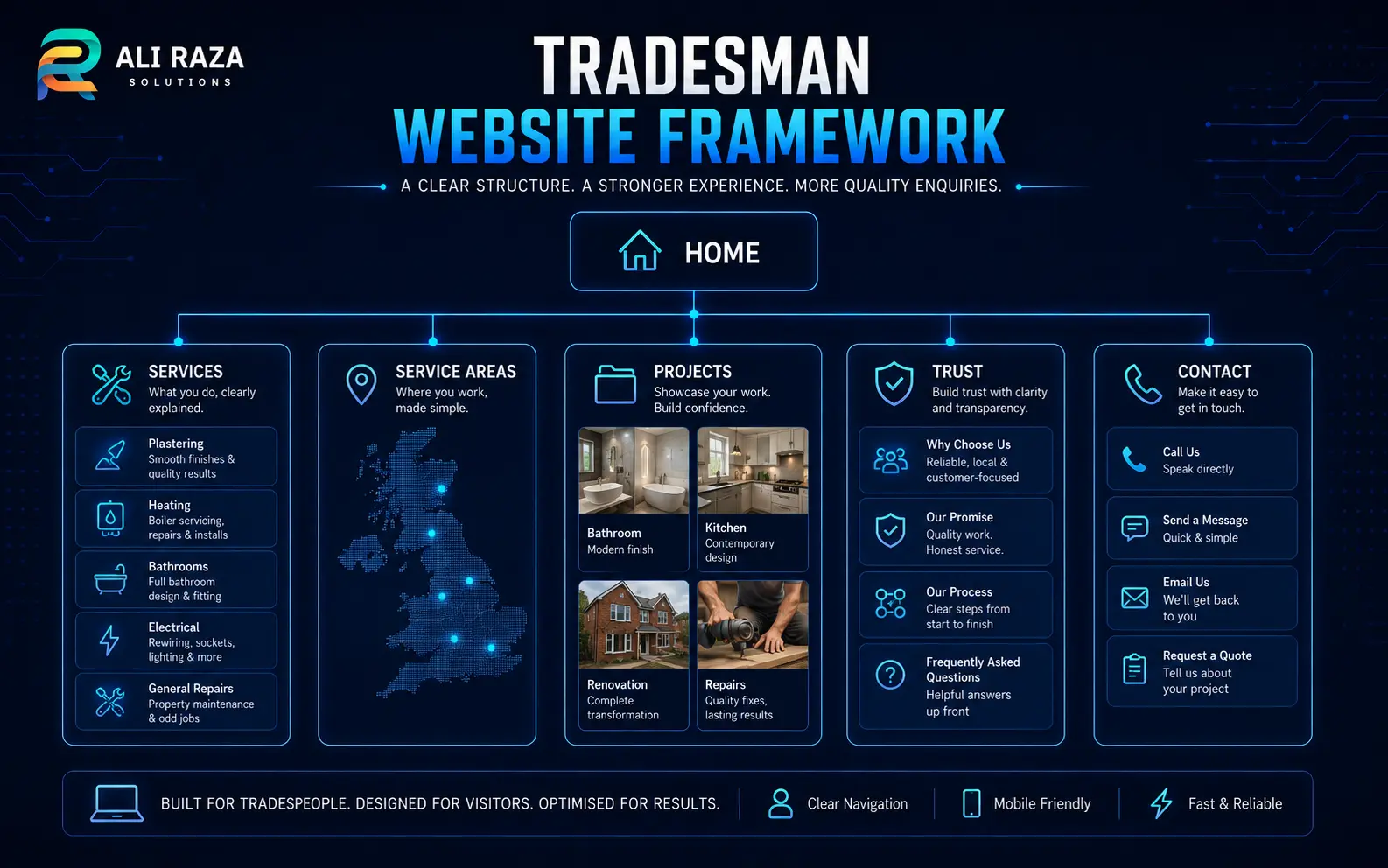
For a UK tradesman website, dedicated service pages make sense when each service has different customer questions, project considerations or search intent. An electrician may need separate pages for rewires, consumer-unit work and commercial electrical services; a builder may separate extensions, renovations and structural work.
Each page should explain what the service covers, who it is suitable for, the typical process, relevant project examples and how to request an estimate or conversation. Link related services naturally so customers can move between them without returning to the homepage.
Ali Raza Solutions structures this kind of architecture through its WordPress development service and broader web development work.
Use Service-Area Pages Carefully
A UK tradesman website can explain the towns, boroughs or wider areas the business genuinely serves, but local SEO is not improved simply by publishing large numbers of near-identical location pages. A useful service-area page needs a real reason to exist.
Where a location has enough relevance, include specific services available there, genuine project context where you have it, travel or coverage details, and links to the services customers in that area commonly need. If the only difference between two pages is the town name, combine or rethink the structure rather than generating thin duplicates.
| Page type | Useful when | Avoid |
|---|---|---|
| Main service page | The service has distinct customer intent and enough useful detail. | Mixing unrelated services into one generic page. |
| Service-area hub | You cover a defined region and customers need clear geographic guidance. | Huge lists of place names with no useful context. |
| Town/location page | There is genuine local relevance, project context or distinct service information. | Duplicating the same template across dozens of towns. |
| Project page | A real completed project illustrates the work clearly. | Presenting stock imagery as completed client work. |
Show Genuine Work and Trust Signals
Trust is especially important for a UK tradesman website because a customer may be inviting the business into a home, workplace or construction project. The strongest proof is specific and verifiable: real project photographs, clear descriptions of the work, genuine qualifications, accurate memberships and customer feedback presented in context.
If a trade is regulated or a particular type of work requires specific registration, do not use generic badges as decoration. Only display the scheme, qualification or membership that genuinely applies to the business and the services it offers.
On a UK tradesman website, project pages can be simple. Explain the customer need without revealing private information, what type of work was carried out, the broad location where appropriate, and what the finished result involved. If an image is an illustration or stock asset, label it honestly rather than implying it is client work.
Design the UK Tradesman Website Around the Lead Journey
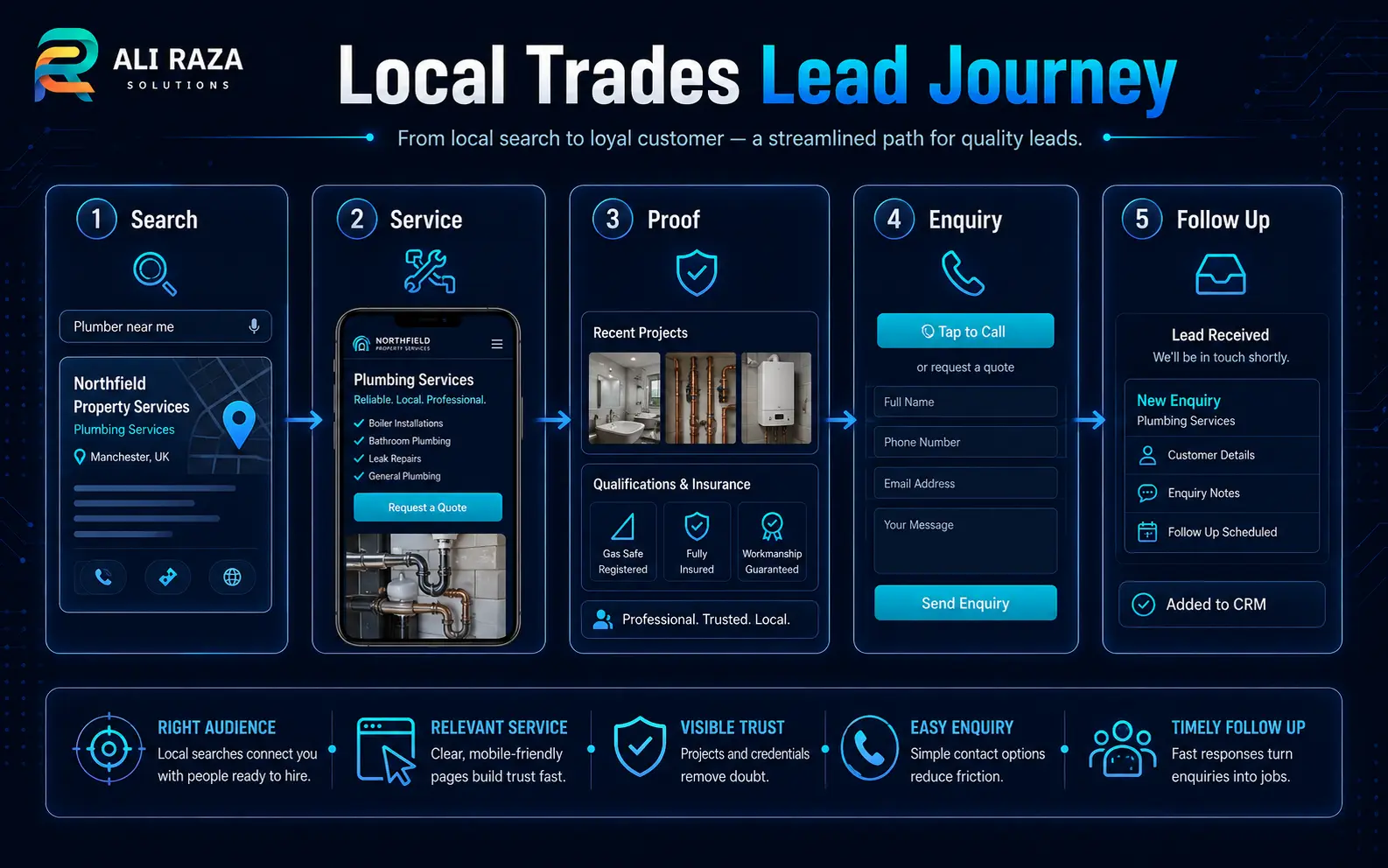
A UK tradesman website should shorten the distance between a local need and a qualified enquiry. A customer may arrive from Google, a recommendation, a directory, social media or a vehicle sign. The website should help all of them confirm service fit and take the next step.
Search or referral
The customer arrives with a service need, location and level of urgency.
Service page
The page confirms that the business handles the relevant job and covers the area.
Proof and trust
Projects, qualifications, company information and useful explanations reduce uncertainty.
Enquiry
The customer calls or submits a concise quote request with enough information for sensible follow-up.
Connect Google Business Profile With the Website
For a UK tradesman website, Google Business Profile and the website should reinforce the same real-world business information. Keep the official website destination, business identity, service information, phone details and customer-facing location or service-area information accurate.
Google says local results are mainly determined by relevance, distance and popularity. The website can support relevance with clear service and location information, while the profile helps Google and users understand the local business. Neither should be treated as a guaranteed ranking shortcut.
On the trades business’s own site, appropriate LocalBusiness structured data can provide machine-readable business details such as name, contact information and opening hours when those details are accurate and visible. Google’s LocalBusiness structured data documentation is the implementation reference.
For the ranking principles themselves, see Google’s official local ranking guidance.
UK Website Trust and Compliance Basics
A UK tradesman website should also reflect the actual business structure and data practices. This section is general implementation guidance rather than legal advice, because requirements differ between sole traders, partnerships, limited companies and the tracking or marketing technologies a site uses.
Limited-company website disclosures
GOV.UK says limited companies must show specified information on their websites, including the registered company number, registered office address, where the company is registered, and the fact that it is a limited company. That rule should not be copied blindly onto a sole trader’s site as though every business structure has identical requirements.
See GOV.UK’s current company stationery and website guidance for the exact requirements that apply to limited companies.
Privacy, forms and cookies
If a quote form collects names, phone numbers, email addresses or project details, the business should provide appropriate privacy information about how that personal data is used. Cookie and similar-technology controls should reflect the technologies actually present on the site.
The ICO’s current guidance says valid consent, where consent is required, must be freely given, specific and informed and involve an unambiguous positive action. Strictly necessary technologies can be treated differently from optional analytics or advertising technologies depending on the setup. See the ICO’s cookies and similar technologies guidance.
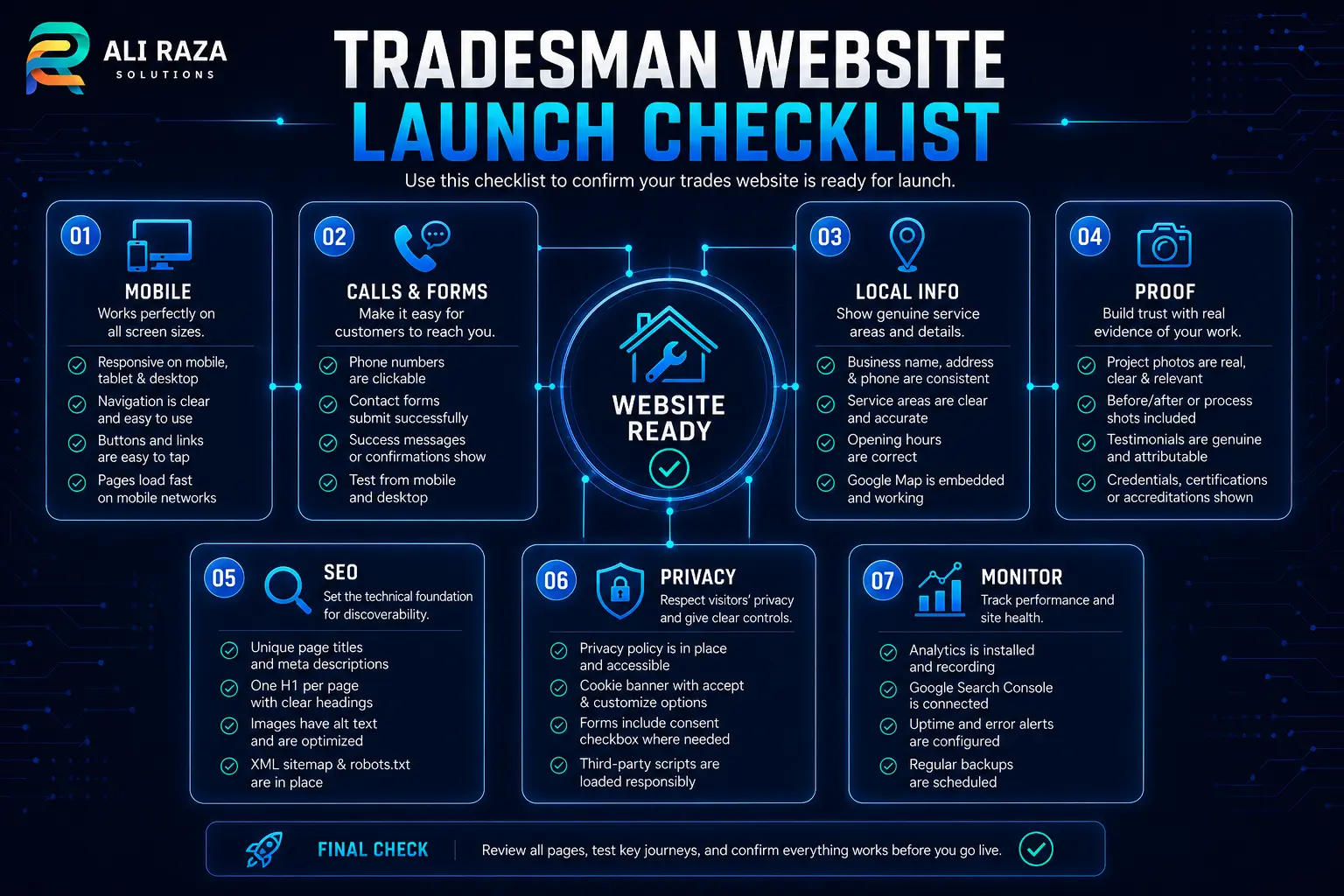
UK Tradesman Website Launch Checklist
Before promoting a new UK tradesman website, test the complete customer journey rather than only checking whether the homepage looks polished. Use a mobile phone, browse the service pages, call the number, submit the quote form and confirm the business receives the enquiry.
- Homepage clearly states the trade, core services and genuine service area.
- Main services have useful, crawlable pages.
- Phone numbers are tap-to-call on mobile.
- Quote forms are short enough for first contact and tested end to end.
- Project imagery and testimonials are genuine and correctly labelled.
- Qualifications, memberships and insurance claims are accurate.
- Service-area information is useful rather than duplicated across thin town pages.
- Google Business Profile points to the correct website and business details align.
- Page titles, headings, internal links and indexing settings are reviewed.
- Analytics or conversion tracking is tested where used.
- Privacy and cookie controls reflect the actual data and technologies in use.
- Limited-company disclosure information is present when it applies to the business.
If the business needs a custom build, use the Ali Raza Solutions contact page to share the trade, main service area, existing website, required quote workflow and any integrations that need to be included.
Frequently Asked Questions About a UK Tradesman Website
These answers cover common planning questions for UK trade businesses building or improving a lead-generation website.
What should a UK tradesman website include?
It should clearly explain the trade, services, genuine coverage area, contact details and quote process. Useful service pages, real project evidence, accurate trust information, mobile call actions, a tested enquiry form and basic local SEO foundations are also important.
Does a tradesman need a website if they have Google Business Profile?
A website is still useful because it gives the business more control over service explanations, project proof, conversion pages, structured content and the enquiry journey. Google Business Profile supports local discovery, while the website can provide deeper information and conversion paths.
How many service pages should a trades website have?
There is no fixed number. Create separate pages when services have distinct customer intent and enough useful information to justify their own destination. Avoid creating pages purely to increase the page count.
Should I create a webpage for every town I serve?
Not automatically. A town page should provide real local value, such as genuine service information or project context. Publishing many near-identical pages with only the town name changed can create thin, repetitive content.
How can a tradesman website generate more leads?
Make the service and coverage area obvious, show genuine proof, reduce friction in the enquiry process, use clear calls to action and measure which pages and sources produce useful enquiries. No website feature can guarantee a specific number of leads.
What should I put on a tradesman homepage?
Lead with the main trade or specialism, location or coverage area and primary enquiry action. Follow with main services, project evidence, trustworthy business information, service-area guidance and a clear contact or quote section.
Does a UK trades website need a privacy policy?
If the site collects personal data through forms, analytics or other tools, it should provide appropriate privacy information about how that data is used. The exact requirements depend on the business and processing activities, so obtain professional advice where needed.
What company information does a UK limited company need on its website?
GOV.UK says a limited company website must show the registered company number, registered office address, where the company is registered and the fact that it is a limited company, usually through its full legal name including “Limited” or “Ltd”.
Is WordPress suitable for a tradesman website?
Yes. WordPress can support service pages, local content, project galleries, quote forms, structured data and integrations. It also needs responsible hosting, updates, backups and maintenance, so the platform should be configured around the business rather than installed and ignored.

About Ali Raza Solutions
Ali Raza Solutions provides WordPress development, web development, SEO and website maintenance services for businesses in the United Kingdom, United States and international markets.
This guide provides general website, SEO and compliance information and is not legal advice. UK requirements vary by business structure and the technologies or data-processing activities used on a particular website.