Law Firm Website SEO: 9 Essential Fixes for Stronger Local Visibility
A practical framework for connecting practice-area architecture, local search, attorney credibility, technical performance and responsible consultation intake.
Published: August 6, 2026 · Approximate reading time: 16 minutes
Explore the framework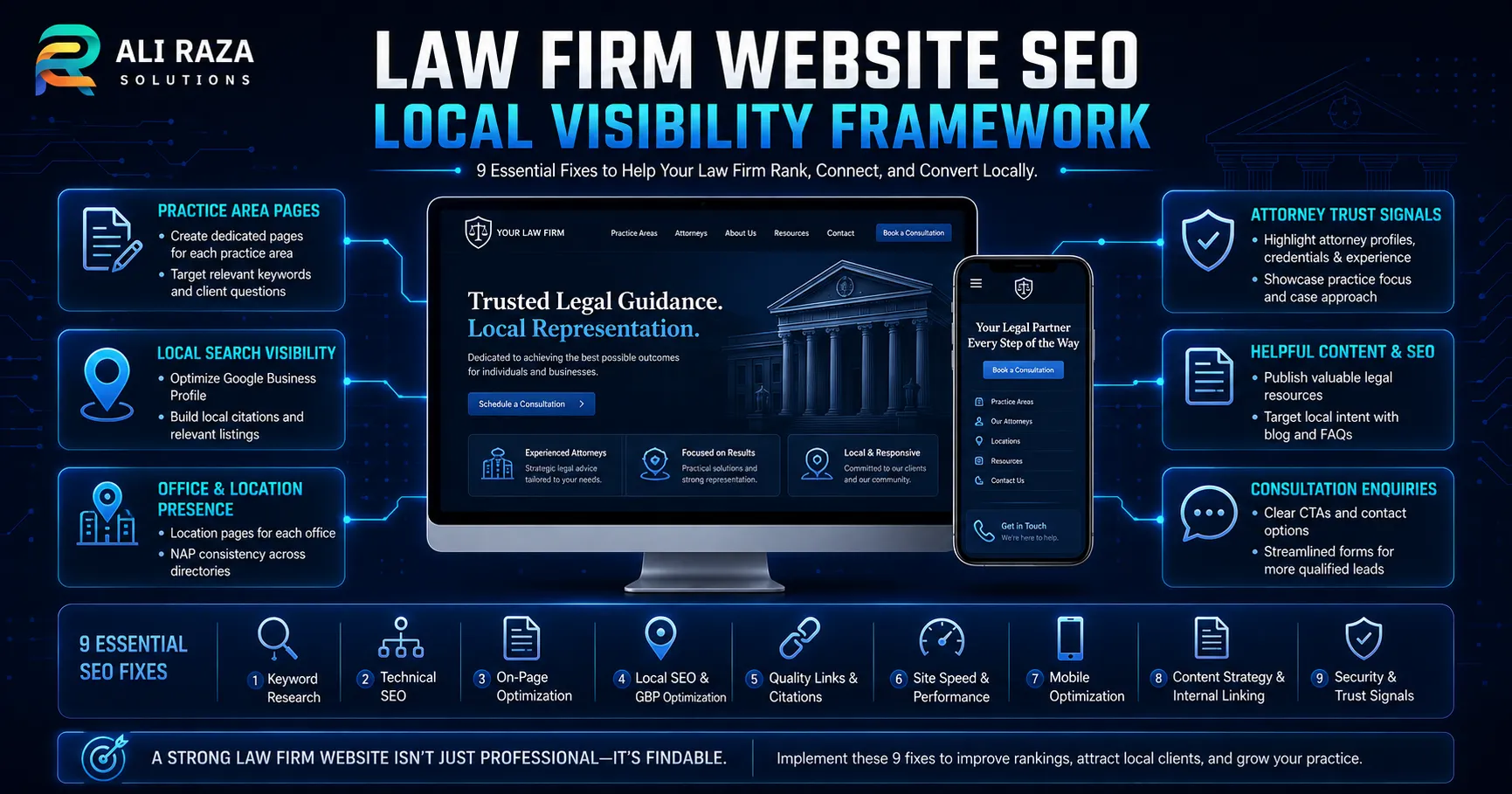
Law firm website SEO works when the website explains what the firm does, where it can help, who provides the service and how a prospective client can take the next appropriate step. It combines useful legal information, local relevance, credible attorney profiles, technical accessibility and measured intake rather than relying on isolated keyword edits.
The goal is not simply more traffic. A legal website should help the right people understand whether the firm may be relevant while protecting accuracy and professional responsibility. Qualified consultations and suitable matters matter more than raw clicks.
Law Firm Website SEO: The Nine-Part Framework
A durable law firm website SEO program addresses the whole client journey. These nine areas expose missing pages, weak trust signals, technical barriers and disconnected intake.
Intent and scope
Define the practice areas, jurisdictions, office locations and types of enquiries the firm can responsibly serve.
Site architecture
Give important services, attorneys, offices and legal resources clear positions in the website hierarchy.
Practice pages
Answer real client questions with accurate, substantial information and a clear next step.
Attorney credibility
Connect verified experience, admissions and professional activity to the services each attorney provides.
Local visibility
Align genuine office pages with accurate Business Profile information and location-specific service details.
Technical health
Remove mobile, speed, crawl, indexing, redirect and form problems that interrupt discovery or intake.
Helpful content
Publish maintained legal explanations built around genuine questions, not mass-produced keyword variations.
Consultation paths
Make calls and forms clear while setting appropriate expectations about conflicts, confidentiality and representation.
Measurement
Connect search data to qualified enquiries, consultations and signed matters where attribution is reliable.
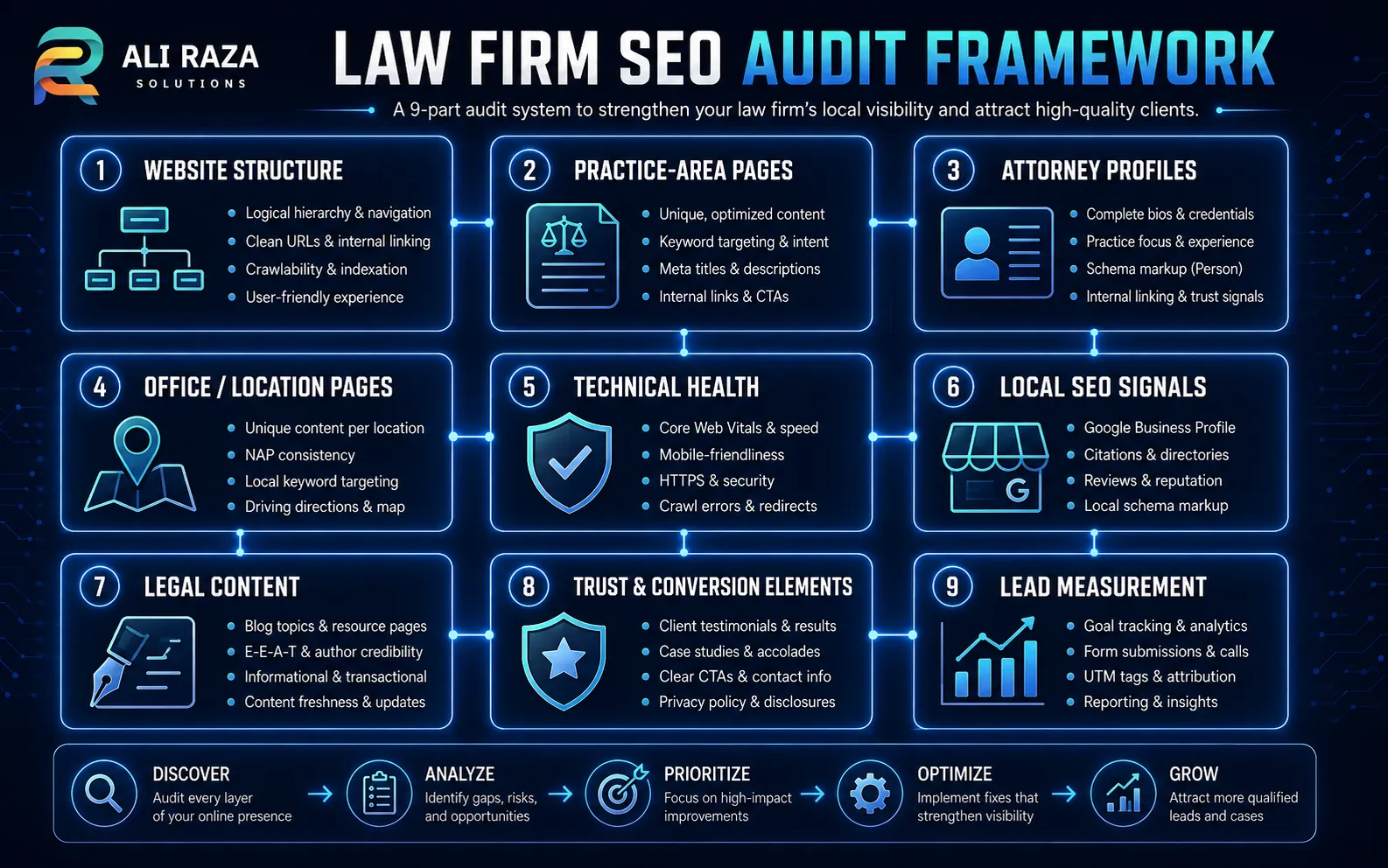
Effective law firm website SEO is a systems project. Improving only titles or publishing articles cannot compensate for unclear services, weak attorney profiles, false location signals, technical problems or an intake process that does not record lead quality.
Build a Search-Friendly Legal Website Architecture
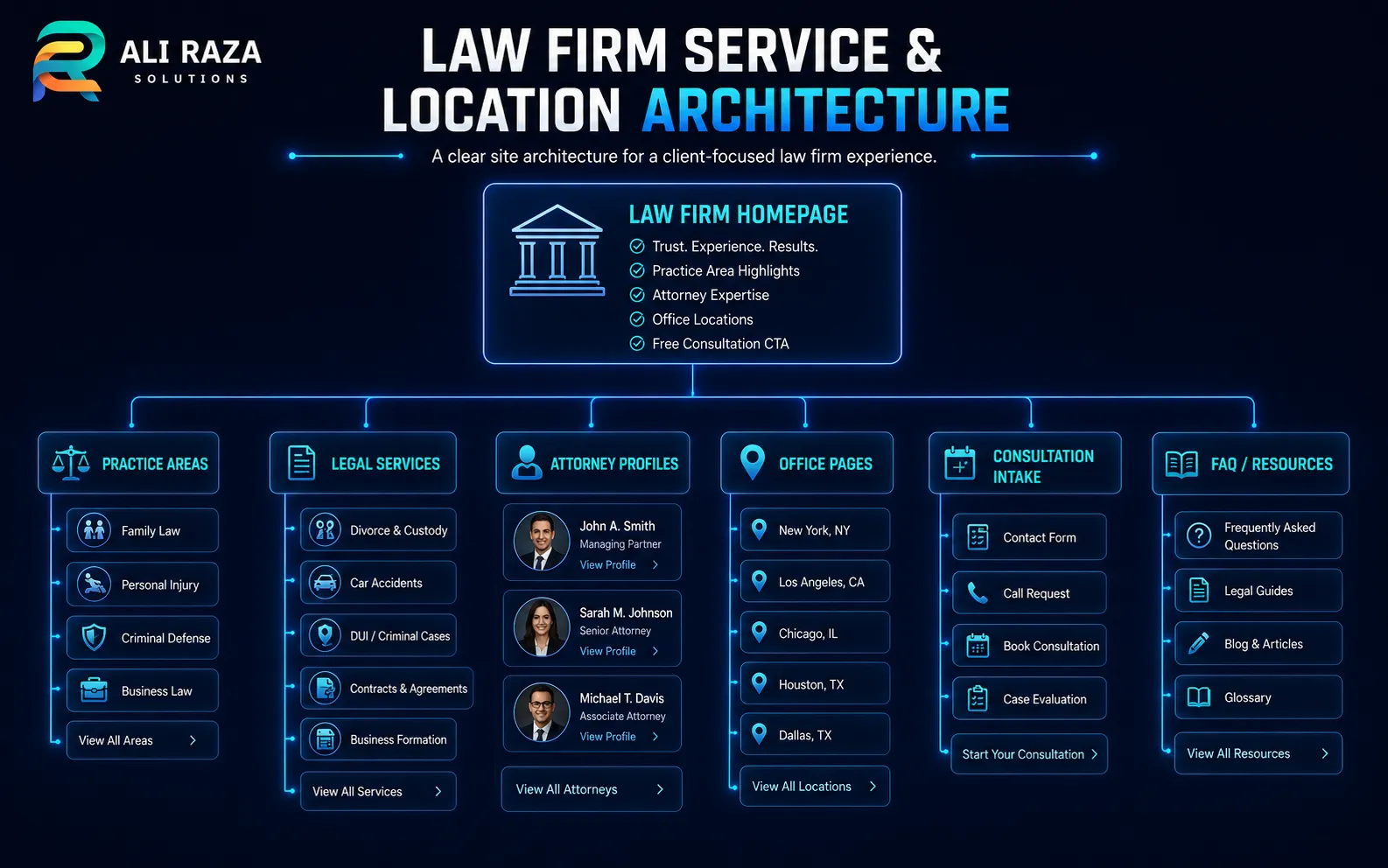
A prospect should move from a broad practice area to a specific service, relevant attorney, genuine office and consultation path without guessing. Search engines also need crawlable links. Google’s Search Essentials recommends using the words people search for in prominent page locations and making links crawlable.
A practical law firm website SEO structure includes a homepage, practice hubs, service pages, attorney profiles, office pages, resources and a contact page. Problems arise when every service is hidden on one page or thin pages compete for nearly identical terms.
Practice-area hubs
Introduce a major area of law, organize related services and link to the attorneys and resources that support it.
Specific service pages
Address a distinct legal need, process or audience with enough substance to justify a separate page.
Attorney profiles
Show verified qualifications and connect each professional to the matters and content they actually handle.
Office pages
Represent real locations with accurate access, service, lawyer and appointment information.
Create Useful Practice-Area Pages
A strong practice page explains the service, relevant situations, general process, jurisdiction and lawyers involved. It should help a reader choose the next step without presenting general content as personalized legal advice.
For law firm website SEO, Google says its ranking systems are designed to prioritize helpful, reliable, people-first content. For law firm website SEO, that means original explanations reviewed by someone qualified to confirm the legal substance. A copied summary, lightly changed city page or vague service description provides little reason for a reader to trust the page.
Recommended practice-page components
- A direct description of the service and the jurisdiction covered
- Common situations, documents or decisions connected to the matter
- A general process and realistic expectations without outcome promises
- Relevant attorney profiles and genuine office information
- Frequently asked questions and links to deeper resources
- A consultation action with approved privacy and relationship language
Make Attorney Expertise Visible and Verifiable
Attorney profiles connect a named professional with specific legal services. Include the attorney’s role, admissions, education, relevant experience and professional activities only where each detail can be verified.
Link profiles to related practices and articles. Law firm website SEO gains credibility when the people behind the information are clear, but unsupported “best,” “leading,” specialist or award claims weaken trust.
Show evidence
Use accurate admissions, experience, publications and professional participation rather than generic claims of excellence.
Keep profiles current
Update departures, promotions, office changes, contact details and practice responsibilities promptly.
Connect expertise
Link each attorney to relevant services and resources instead of leaving the profile isolated.
Review terminology
Confirm whether specialist, expert, award and comparison language is allowed in every relevant jurisdiction.
Align Local SEO, Business Profiles and Real Offices
Google explains that local results are mainly based on relevance, distance and prominence. Its local ranking guidance also emphasizes complete and accurate Business Profile information. A law firm can improve relevance and prominence signals, but it cannot control the searcher’s distance or guarantee a map position.
Keep the business name, address, phone, hours, categories and website destination accurate. Link a genuine profile to the relevant office page. Include lawyers serving the office, available practices, appointments and directions where useful.
| Element | Website evidence | Business Profile check |
|---|---|---|
| Office identity | Accurate name, address, phone and location details | Matching verified information |
| Services | Practice pages connected to the office | Appropriate primary and secondary categories |
| Availability | Real hours and appointment expectations | Current regular and special hours |
| People | Attorneys genuinely serving the location | No misleading practitioner or duplicate profiles |
| Reputation | Accurate credentials and community information | Authentic review monitoring and responses |
Use review requests and responses only in ways permitted by the platform and applicable professional rules. Do not condition incentives on positive feedback or edit a testimonial until it creates a misleading impression.
Fix the Technical Foundation Before Scaling Content
Law firm website SEO can fail behind slow pages, unstable mobile layouts, broken navigation or indexing mistakes. Audit crawlability, canonical URLs, sitemaps, HTTPS, redirects, duplicate pages, forms and analytics.
Test the real consultation path on mobile and desktop, including click-to-call links, form validation, confirmation messages and tracking. Technical work is complete only when users and search engines can reach the intended page reliably.
Crawl and indexation
Confirm important pages are discoverable, canonicalized correctly and included in a maintained XML sitemap.
Mobile usability
Keep navigation, text, tables, forms and tap targets readable on smaller screens.
Performance
Compress media, reduce avoidable script weight and test representative templates rather than only the homepage.
Conversion tracking
Record calls and forms responsibly, verify events and separate spam from qualified enquiries.
Use structured data accurately
Appropriate markup may include Organization or LocalBusiness information, BreadcrumbList, Article and visible FAQ content. Google’s LocalBusiness structured-data documentation explains required properties and validation. Markup must describe visible, accurate information; eligibility never guarantees a particular search appearance.
Publish Legal Content With a Clear Maintenance Owner
Law firm website SEO content can answer process questions, define terms, explain documents and summarize legal changes. Show a publication or update date, link to the relevant service and assign a review owner. Revise time-sensitive material promptly.
Law firm website SEO also depends on internal links. Connect the homepage to practice hubs, hubs to service pages, services to attorneys, articles to the relevant service and offices to the lawyers who work there. Descriptive links help readers continue their research and prevent important pages from becoming isolated.
- Homepage → major practice areas
- Practice hub → individual legal services
- Service page → relevant attorneys and office
- Attorney profile → services and reviewed resources
- Legal article → related service and consultation path
For implementation support, review Ali Raza Solutions’ SEO services and web development services. The website and search strategy should be planned together rather than handed between disconnected teams.
Protect Accuracy, Ethics and Consultation Intake
Legal marketing must satisfy professional rules. ABA Model Rule 7.1 prohibits false or misleading communications about a lawyer or legal services, while Rule 7.2 addresses communications through media. These model rules do not replace the applicable jurisdiction’s requirements.
Before publishing law firm website SEO content, verify outcomes, testimonials, awards, specialist language and required disclosures. The ABA provides jurisdictional comparison charts, but the firm should obtain qualified review for the states and courts relevant to its work.
Do not guarantee results, imply that past outcomes predict a future matter, invent client reviews or describe an attorney as a specialist without confirming the applicable rule. General website guidance is not legal or ethics advice.
Design the form around safe intake
Keep the initial form concise. Ask only what is needed to route the enquiry, display the privacy notice, explain that submission does not automatically create an attorney-client relationship and discourage unnecessary confidential details.
The confirmation process should identify what happens next and avoid promising representation. Law firm website SEO should improve access to the intake process while preserving the firm’s conflict checks and engagement procedures.
Measure Qualified Enquiries, Not Just Traffic
Search impressions and clicks show visibility, not whether the visitor needs the firm. Track the path from landing page to enquiry, qualification, consultation and signed matter where attribution is reliable.
| Metric | What it indicates | Important limitation |
|---|---|---|
| Search impressions | Visibility for monitored queries and pages | Does not prove the result attracted a relevant visitor |
| Organic clicks | Visits arriving from unpaid search | Does not establish lead quality |
| Local profile actions | Calls, directions or website interactions | May include unsuitable or accidental actions |
| Consultation forms | Recorded website enquiries | Can include spam, conflicts or matters outside scope |
| Qualified leads | Enquiries matching the firm’s services | Requires consistent internal classification |
| Signed matters | New engagements attributed to search | Attribution can be incomplete across devices and channels |
Review pages by practice area, location and enquiry quality. A page with modest traffic may be more valuable than a popular article that attracts no suitable matters. Never treat ranking movement as a guarantee of client growth.
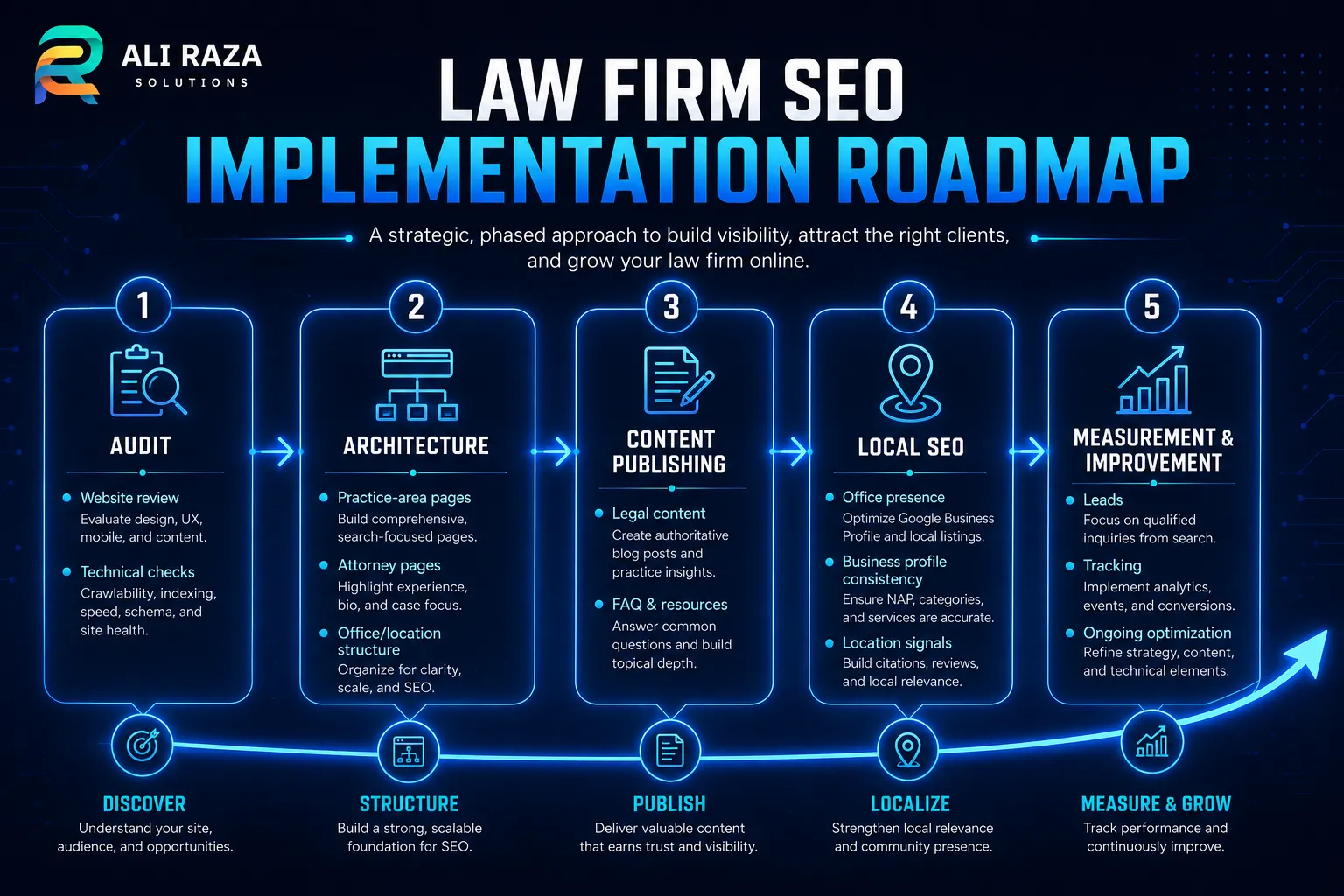
Implement Law Firm Website SEO in Four Phases
Implement law firm website SEO in phases: audit the evidence, correct the architecture, publish reviewed information and improve the system using search and lead-quality data.
Audit
Review search visibility, website structure, local profiles, technical health, content quality and compliance risks.
Rebuild
Improve architecture, service pages, attorney profiles, office evidence, mobile experience and consultation paths.
Publish
Add reviewed resources, contextual links, accurate structured data and approved local information.
Improve
Use Search Console, local visibility and intake feedback to prioritize maintenance without chasing vanity metrics.
Frequently Asked Questions About Law Firm Website SEO
These answers address the most common planning, local-search, content and intake questions.
What is law firm website SEO?
Law firm website SEO is the coordinated improvement of a legal website’s structure, content, technical health, local relevance and consultation paths so search engines and prospective clients can understand the firm. It should support accurate information and qualified enquiries rather than promise rankings.
Does every legal practice area need a separate page?
A separate page is useful when the service has distinct client questions, processes, terminology and search intent. Closely related services may fit within one strong hub. Avoid creating thin pages merely to target small keyword variations.
How does local SEO help a law firm?
Local SEO helps an eligible office appear for geographically relevant searches by aligning the website, office page and Google Business Profile. Complete information, genuine local relevance and prominence signals matter, while proximity remains outside the firm’s control.
Should a law firm create pages for every city it serves?
Not automatically. Create a location page when the firm has a genuine office or can provide substantial, accurate information for that location. Near-identical city pages with little unique value can confuse visitors and weaken the site.
What should an attorney profile include?
Include the attorney’s role, admissions, education, relevant experience, practice responsibilities and accurate professional activities. Link the profile to related services and articles. Verify every credential, award and specialist description before publication.
How often should legal website content be reviewed?
Review high-risk pages whenever laws, procedures, personnel, office details or professional rules change. Establish a documented schedule for practice pages and dated articles, with a qualified person responsible for confirming accuracy.
Can a law firm guarantee first-page rankings?
No responsible SEO provider can guarantee a particular organic or local ranking. Search results vary by competition, location, query, website quality and changes to search systems. A sound program improves the site and measures progress without promising a fixed position.
Which SEO metrics matter most to a law firm?
Track search visibility, qualified organic enquiries, consultation bookings and signed matters where attribution is reliable. Traffic and rankings are useful diagnostics, but they do not show whether an enquiry fits the firm’s services or becomes a client.
Does submitting a website form create an attorney-client relationship?
A law firm should not imply that a form submission automatically creates an attorney-client relationship. The form and confirmation message should explain the intake process, avoid requesting unnecessary confidential details and reflect the firm’s approved legal language.

About Ali Raza Solutions
Ali Raza Solutions provides SEO, WordPress development and digital services for professional-service businesses in the United States and international markets.
This article provides general website and marketing information, not legal or professional-responsibility advice. Advertising, privacy, testimonial, specialist, solicitation and intake requirements vary by jurisdiction. Obtain qualified review before publishing claims or changing the firm’s approved intake language.