Dental Practice Website Checklist: 15 Essential Steps for Safer Growth
A practical framework for building patient-friendly treatment pages, trustworthy provider profiles, accessible appointment paths, local search foundations and maintainable WordPress systems.
Published: August 6, 2026 · Approximate reading time: 14 minutes
Start the checklist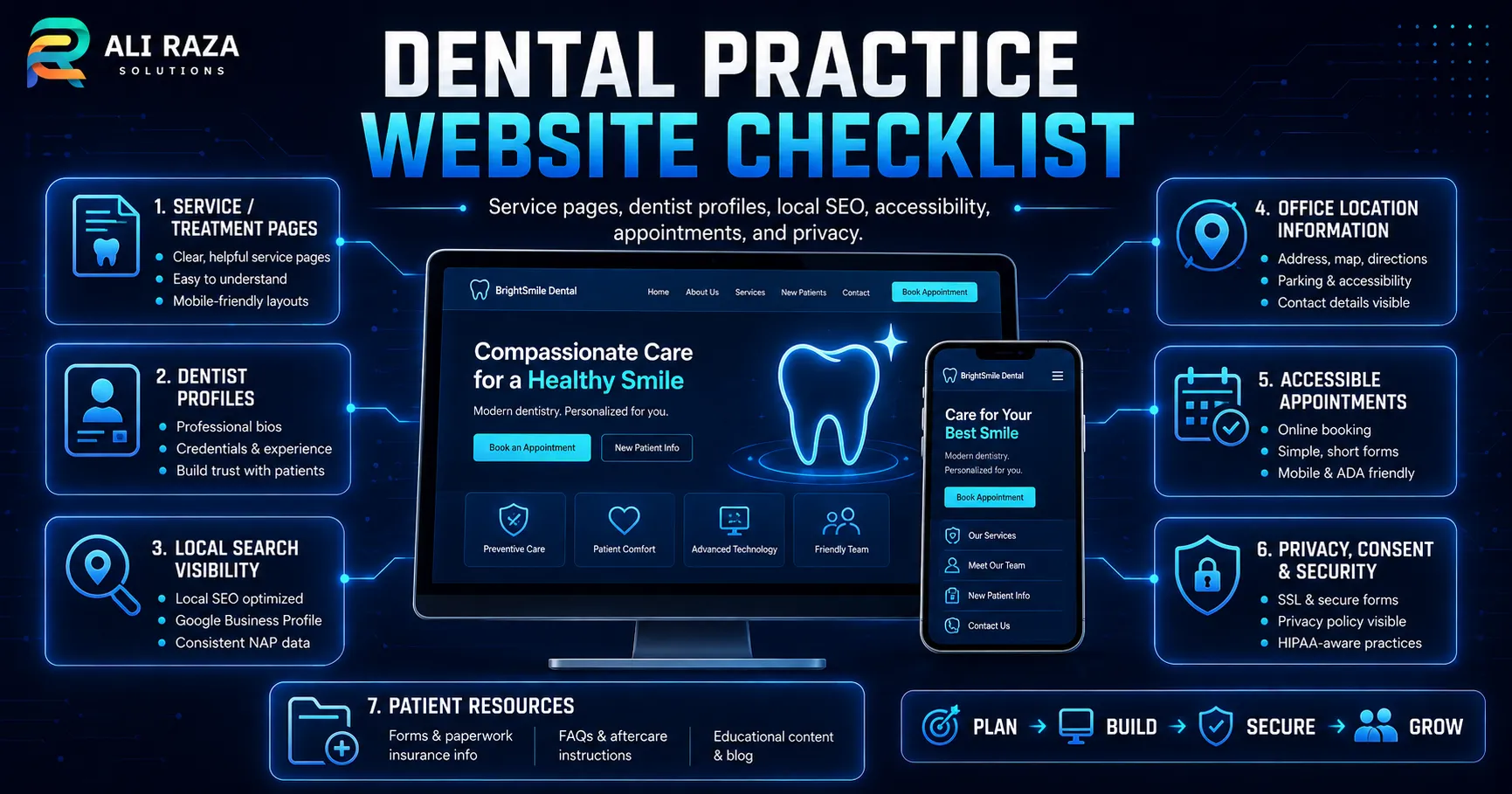
A dental practice website checklist should verify much more than appearance. The site must explain services clearly, identify the dentists and office, support accessible appointment requests, align with local-search information, protect submitted data and remain reliable after launch.
The goal is a dependable patient-information system that reflects the practice, routes people correctly and has an accountable maintenance owner.
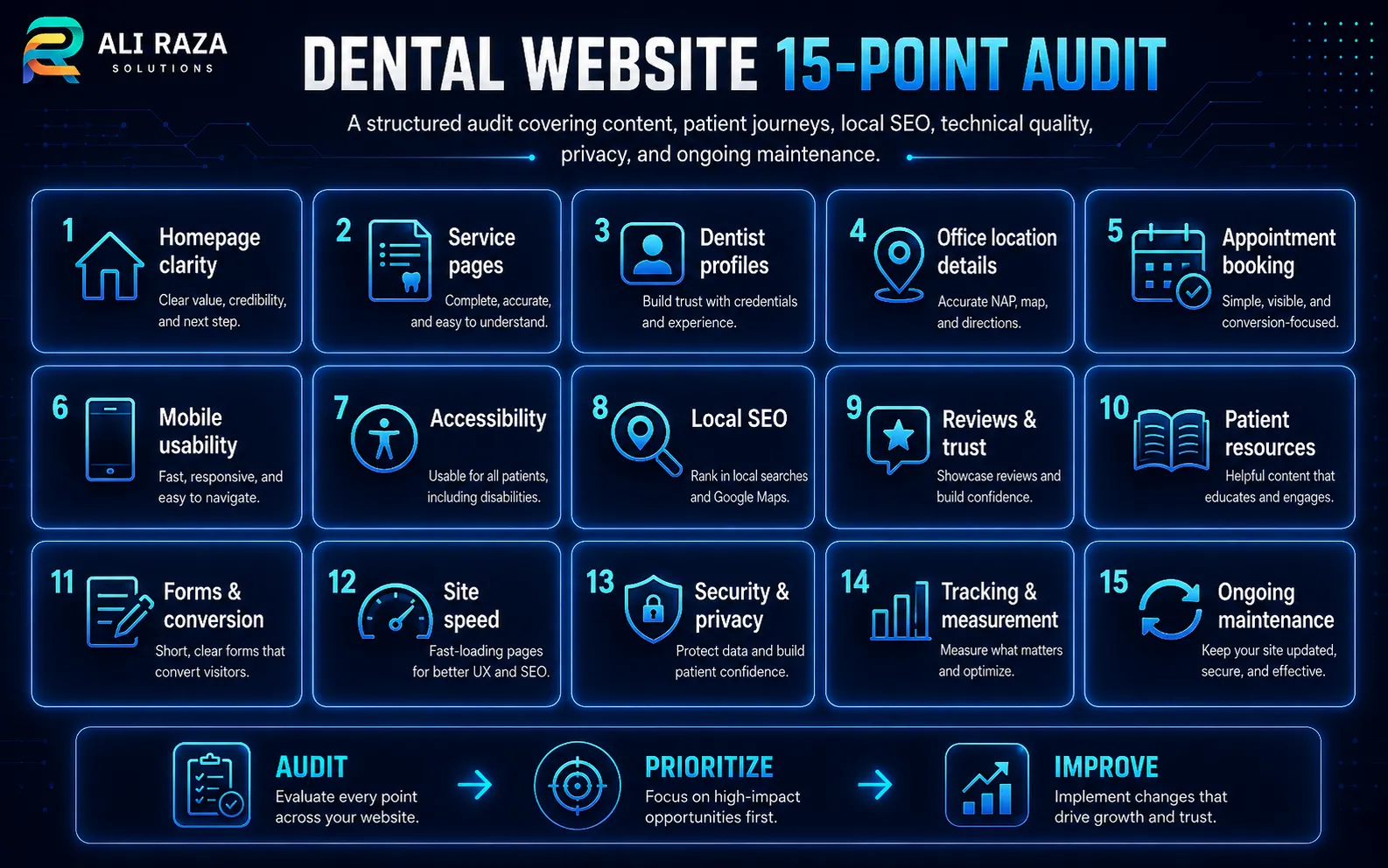
Dental Practice Website Checklist: 15 Essential Requirements
Use this dental practice website checklist during discovery, development and pre-launch review. Give every item a named owner and a clear acceptance test.
Define the practice and goal
Confirm the locations, services, audiences, emergency process and primary appointment action before designing pages.
Map patient questions
List what new and returning patients need to understand before they call, request an appointment or use a portal.
Build useful service pages
Give important treatments enough space for accurate explanations, suitability context, process information and next steps.
Publish dentist profiles
Verify names, roles, education, professional information, clinical focus and office assignments before publication.
Complete location details
Show accurate addresses, hours, telephone numbers, directions, accessibility information and services offered at each real office.
Prioritize appointments
Keep telephone, request and portal actions easy to identify without disguising the difference between a request and a confirmed booking.
Design mobile first
Test navigation, telephone links, forms, schedules and long treatment pages on narrow screens and touch devices.
Make forms accessible
Use persistent labels, useful instructions, keyboard support, clear errors and a confirmation message after submission.
Review privacy
Document every system that receives form, scheduling, analytics or advertising data and obtain qualified review where required.
Verify marketing claims
Check credentials, testimonials, technology descriptions and treatment claims for accuracy, context and jurisdictional requirements.
Align local search
Match the website, office pages and eligible Business Profiles with complete, current and consistent practice information.
Improve performance
Control image weight, fonts, scripts and scheduling tools while monitoring real mobile loading and interaction behavior.
Add accurate schema
Use structured data that matches visible organization, office, article and breadcrumb information without inventing ratings.
Test every conversion
Verify calls, forms, appointment tools, email notifications and analytics events from submission through practice follow-up.
Assign maintenance
Document responsibility for updates, backups, content accuracy, provider changes, integrations and recovery testing.
Dental Practice Website Checklist for Homepages and Treatment Pages
A strong homepage identifies the practice, location, major services and appointment path quickly. A slogan cannot replace this basic information.
Use the dental practice website checklist to confirm the practice name, telephone number, hours, treatments, dentists, location access, emergency guidance and new-patient information. Insurance and financing statements must match current policies.
Give important treatments dedicated pages
A useful treatment page explains the service, why it may be discussed, what evaluation may involve and the next step. It should not diagnose the reader or imply universal suitability.
Explain the service
Describe the treatment, consultation and general process accurately. Define unfamiliar terms and avoid copied manufacturer language.
Connect the provider
Link to the dentist or team responsible for the service and identify the real office where it is available.
Set expectations
Discuss evaluation, variability, limitations and aftercare at an appropriate level without promising an individual outcome.
Offer a next step
Use a clear consultation or appointment-request action, plus an alternative telephone path for people who need assistance.
Dental Practice Website Checklist for Dentist Profiles and Offices
Patients often evaluate the clinician and location first. A dental practice website checklist should treat provider and office pages as primary information.
A dentist profile can include the professional name, role, photograph, education, training, memberships, languages, clinical focus and office locations. Verify every credential, award and specialist description.
Build one useful page for each real office
Each genuine location page should provide the address, telephone number, hours, map, access information, providers, services, emergency instructions and appointment options. Original photographs can help patients recognize the office.
Do not create dozens of nearly identical city pages merely to target place names. A page should serve a real office or provide substantial, accurate information that is useful to patients in that location.
Dental Practice Website Checklist for Appointments and Privacy
The appointment path must state what happens next. A request is not a confirmed booking, and a portal may be for existing patients only.
Use the dental practice website checklist to test calls, forms, scheduling, portal links, confirmations and emergency instructions. Avoid unnecessary clinical detail in a general marketing form.
| Channel | Best use | Important review |
|---|---|---|
| Telephone | Urgent questions, accessibility needs and assisted booking | Mobile click-to-call behavior, hours and after-hours message |
| Appointment-request form | Simple new-patient contact and preferred-time collection | Requested fields, storage, notifications and confirmation wording |
| Scheduling platform | Availability-led appointment selection | Data handling, mobile usability, integration ownership and failure path |
| Patient portal | Established-patient communication and records workflows | Authentication, access instructions and separation from marketing forms |
Covered entities and business associates should assess forms, appointment providers, analytics, advertising tags, hosting and email notifications. HHS maintains current HIPAA guidance for regulated organizations, including online-tracking material. A plugin badge does not establish compliance.
Accessible Patient Experience and Form Design
An accessible dental practice website checklist tests real tasks: keyboard navigation, readable enlarged text, clear form labels and recovery from input errors.
The W3C describes WCAG as an international accessibility standard. Its form guidance emphasizes descriptive labels, instructions and useful feedback.
Structure and navigation
Use logical headings, descriptive links, keyboard-accessible menus, visible focus and a predictable page order.
Readable presentation
Maintain sufficient contrast, scalable text, understandable language and information that is not conveyed through color alone.
Form completion
Provide persistent labels, required-field instructions, clear validation errors and a programmatically meaningful confirmation.
Media and motion
Add text alternatives, captions where needed and controls for movement. Do not let decorative animation interfere with reading.
Dental Practice Website Checklist for Trust and Claims
This dental practice website checklist treats trust as verifiable information: named dentists, current credentials, real office photography, accurate policies and clear next steps. Unsupported superlatives and invented awards weaken it.
The American Dental Association says dental advertising should be truthful, non-deceptive and fair, with evidence supporting claims. Review current ADA advertising guidance and applicable rules.
Handle testimonials and before-and-after images carefully
Before publishing patient stories or images, review authorization, privacy, ownership, presentation and whether the example creates an unrealistic expectation. Missing context can make a true statement misleading.
Do not publish patient images, treatment outcomes, specialist descriptions, awards or comparative claims until the practice has verified the facts and completed its required privacy, legal and professional review.
Local SEO Foundations for Dental Practices
A dental practice website checklist should connect every office page to accurate Business Profile information. Google says local results mainly use relevance, distance and prominence.
Review Google’s local ranking guidance and Business Profile guidelines before changing practice or practitioner listings. Apply eligibility and naming rules to the real business structure.
- Keep the practice name, address, telephone number and hours accurate.
- Choose categories that reflect the services actually offered.
- Link each profile to the most useful corresponding website page.
- Use genuine office and team photography rather than misleading location imagery.
- Monitor reviews and respond according to approved privacy-aware procedures.
- Connect treatments, dentists and locations through meaningful internal links.
No website change can guarantee a map position because proximity, competition and search context remain outside the practice’s control.
Dental Practice Website Architecture
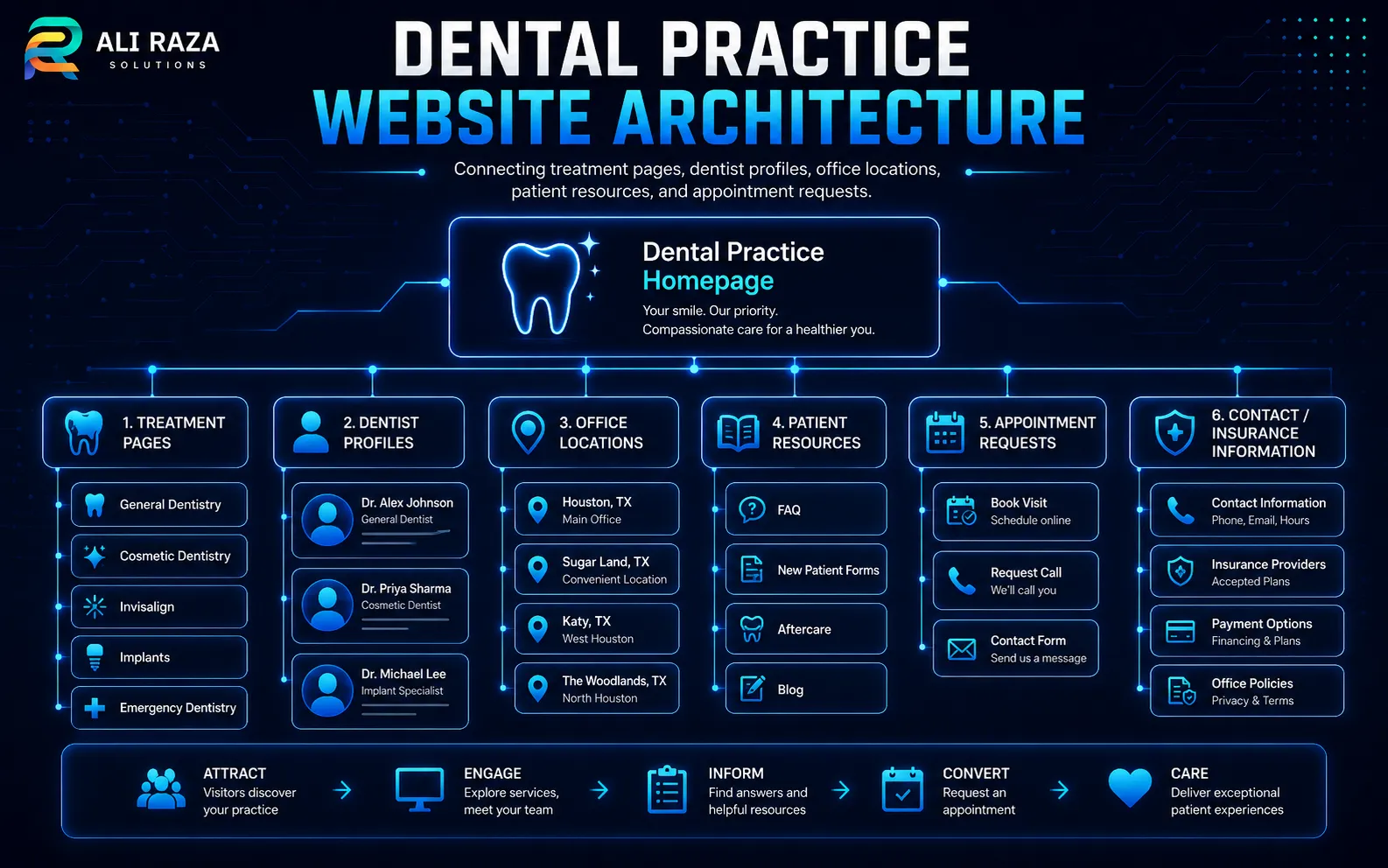
The website should connect each treatment, dentist, office and appointment action. The dental practice website checklist should flag important pages hidden in footers, search tools or isolated landing pages.
A practical structure includes Home, About, Dentists, Treatments, service pages, New Patients, Payment, Offices, Emergency, Resources, Contact and Appointments.
Use internal links to explain relationships
Link services to relevant dentists and locations, profiles to treatment pages, and articles to the appropriate next step. Ali Raza Solutions’ SEO services can support architecture and technical review.
Dental Practice Website Checklist for Technical SEO and Security
The dental practice website checklist should also test HTTPS, crawlability, canonicals, sitemaps, redirects, broken links, mobile layout, image dimensions, caching, forms and Search Console coverage.
Google’s LocalBusiness guidance covers hours and business details. Markup must match visible information and does not guarantee a search feature.
| Area | What to test | Failure risk |
|---|---|---|
| Mobile performance | Hero media, fonts, menus, forms and scheduling scripts | Slow interaction or abandoned appointment paths |
| Indexation | Canonical tags, sitemap entries, redirects and noindex rules | Important pages excluded or duplicate URLs indexed |
| Structured data | Visible business details, breadcrumbs and article markup | Invalid, misleading or conflicting entity information |
| Security | Updates, access, backups, malware monitoring and recovery tests | Compromise, form interruption or unreliable restoration |
| Email delivery | Form storage, notifications, SMTP or API logs and replies | Patient enquiries recorded but not seen by the practice |
Assign ownership for WordPress updates, backups, least-privilege access and restoration tests. Ali Raza Solutions provides WordPress development and website maintenance services.
Measure Appointment Paths, Not Traffic Alone
A useful dental practice website checklist verifies meaningful tracking and reconciliation with scheduling or intake. A click is not a submitted request, attended appointment or new patient.
| Metric | What it indicates | Limitation |
|---|---|---|
| Appointment-button clicks | Interest in starting a booking path | Does not prove completion |
| Telephone clicks | Mobile call intent | Does not prove a connected call |
| Completed forms | Submitted enquiries | Can include spam, duplicates or unsuitable requests |
| Scheduling completions | Booked or requested time slots | May include cancellations and no-shows |
| New-patient enquiries | Potential demand attributed to the website | Requires consistent internal classification |
| Attended appointments | Completed visits | Requires reconciliation with the practice system |
Maintenance is part of the website
Review profiles, hours, services, insurance statements, forms and emergency information whenever the practice changes. Schedule updates, backups, accessibility reviews and test submissions.
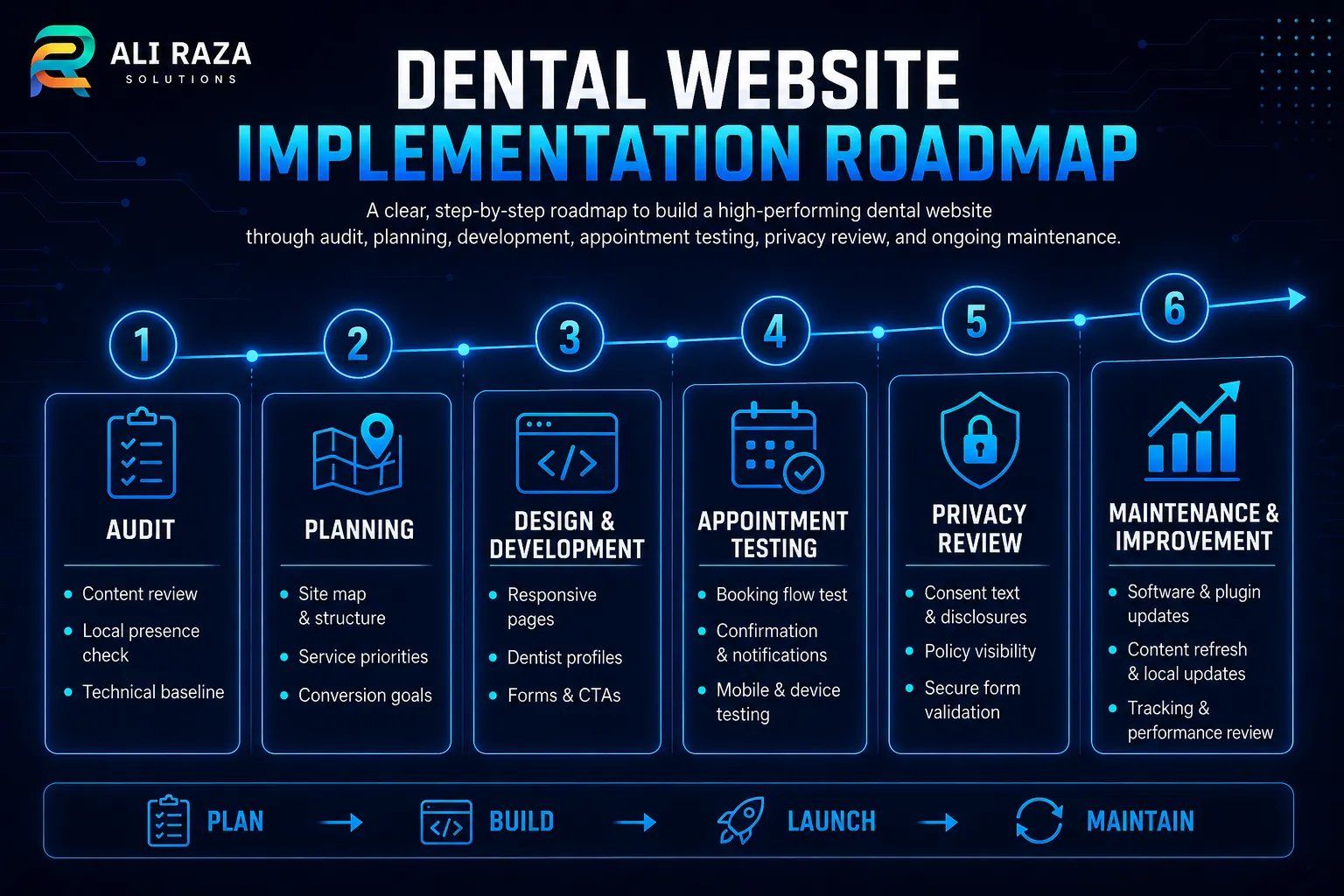
Dental Website Implementation Roadmap
Apply the dental practice website checklist in five phases so visual polish does not outrun content, privacy, accessibility or integration decisions.
Audit
Review the current content, local visibility, mobile experience, accessibility, forms, integrations and technical condition.
Plan
Define patient journeys, architecture, provider and office information, required integrations, measurement and review responsibilities.
Build
Create responsive service pages, profiles, office information, accessible appointment paths, local signals and technical controls.
Validate
Test mobile, keyboard use, forms, telephone links, email, scheduling, analytics, search visibility and approved claims.
Maintain
Assign software updates, content review, provider changes, form monitoring, backups and recovery tests to named owners.
Frequently Asked Questions About Dental Practice Websites
These answers summarize the most important planning, local-search, privacy and maintenance decisions.
What should a dental practice website include?
A complete dental practice website checklist includes clear services, dentist profiles, genuine office information, appointment options, new-patient guidance, accessible forms, privacy review, local SEO, technical maintenance and tested contact workflows.
Does every dental treatment need a separate page?
A separate page is useful when the treatment has distinct patient questions, process information, suitability considerations and search intent. Closely related services can share a well-structured hub. Avoid publishing thin pages only to target small keyword variations.
What should be included on a dentist profile?
Include the dentist’s full professional name, role, current photograph, education, training, professional information, accurate clinical focus, languages and office locations. Verify every credential, award, membership and specialist description before publication.
How does local SEO help a dental practice?
Local SEO aligns the website, real office pages and eligible Business Profiles so search systems and patients can understand where the practice operates and which services it provides. Relevance, distance and prominence influence results, so no map position can be guaranteed.
Should every dental office have its own location page?
Yes, when it is a genuine office with distinct address, hours, providers, services and access information. The page should help patients use that location. Avoid creating duplicate pages for places where the practice has no real presence.
Can a dental website use an ordinary contact form?
A general enquiry form may be suitable for limited contact information, but the practice should review what data is requested, where it is stored, who receives it and which vendors process it. Avoid asking for unnecessary clinical details through a marketing form.
Does a dental website need to comply with HIPAA?
HIPAA applicability depends on the organization, the information involved and how technologies are used. Covered entities and business associates should assess forms, portals, scheduling, analytics and tracking with qualified privacy and legal guidance rather than relying on a generic compliance claim.
How should before-and-after dental images be handled?
Review authorization, privacy, ownership, accuracy, presentation and applicable advertising rules before publishing. Explain that outcomes vary and avoid selecting or editing examples in a way that creates a misleading expectation.
What accessibility features should a dental website include?
Use logical headings, keyboard-accessible navigation, visible focus, sufficient contrast, descriptive links, text alternatives, persistent form labels, useful instructions, clear errors and confirmation messages. Test real appointment and contact tasks instead of relying only on an automated score.
Which dental website conversions should be tracked?
Track completed appointment requests, scheduling completions, telephone actions and other meaningful contact steps. Where possible, reconcile them with qualified enquiries and attended appointments. Traffic and button clicks alone do not measure patient value.
How often should a dental practice website be updated?
Update the site whenever dentists, services, locations, hours, policies or systems change. In addition, schedule software maintenance, test submissions, backup reviews, accessibility checks and content verification throughout the year.
Can website design guarantee more patients?
No. A clearer, faster and more trustworthy website can improve the patient journey, but appointments depend on demand, location, reputation, competition, availability, follow-up and other factors. Responsible providers do not guarantee patient volume.

About Ali Raza Solutions
Ali Raza Solutions provides WordPress development, maintenance and SEO services for professional and healthcare businesses.
This article provides general website and marketing information, not clinical, privacy or legal advice. It does not determine HIPAA applicability or compliance. Requirements vary by jurisdiction; obtain qualified review for systems and claims.